
Today’s corporate leaders increasingly understand that getting employees back into the office isn’t about creating mandates. It’s about creating a sought-after experience. When the office is thoughtfully designed to prioritize your wellbeing, enhance your focus, and facilitate meaningful connections, it becomes an asset instead of an obligation.
To turn that design philosophy into reality, organizations are increasingly hiring workplace experience strategists to help guide, budget, and execute these transformations from the inside out. In 2024, we had the opportunity to work with Enterprise Workplace Transformation Leader Wendy Waite when she was at TIAA, and we were curating an art package for their new Frisco, Texas office tower.
More recently, Wendy and Art + Artisans CEO and founder Jennifer Brener Seay sat down to discuss the evolution of workplace experience, the need for analog moments at work and the role of art in that context. Plus, the importance of getting art in the construction budget early and what to do if you miss that window.
The Evolution of Workplace Experience Since COVID
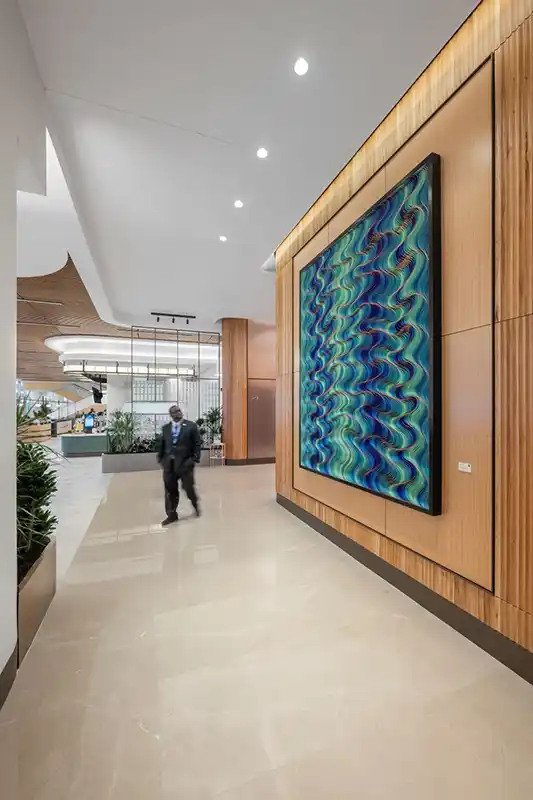
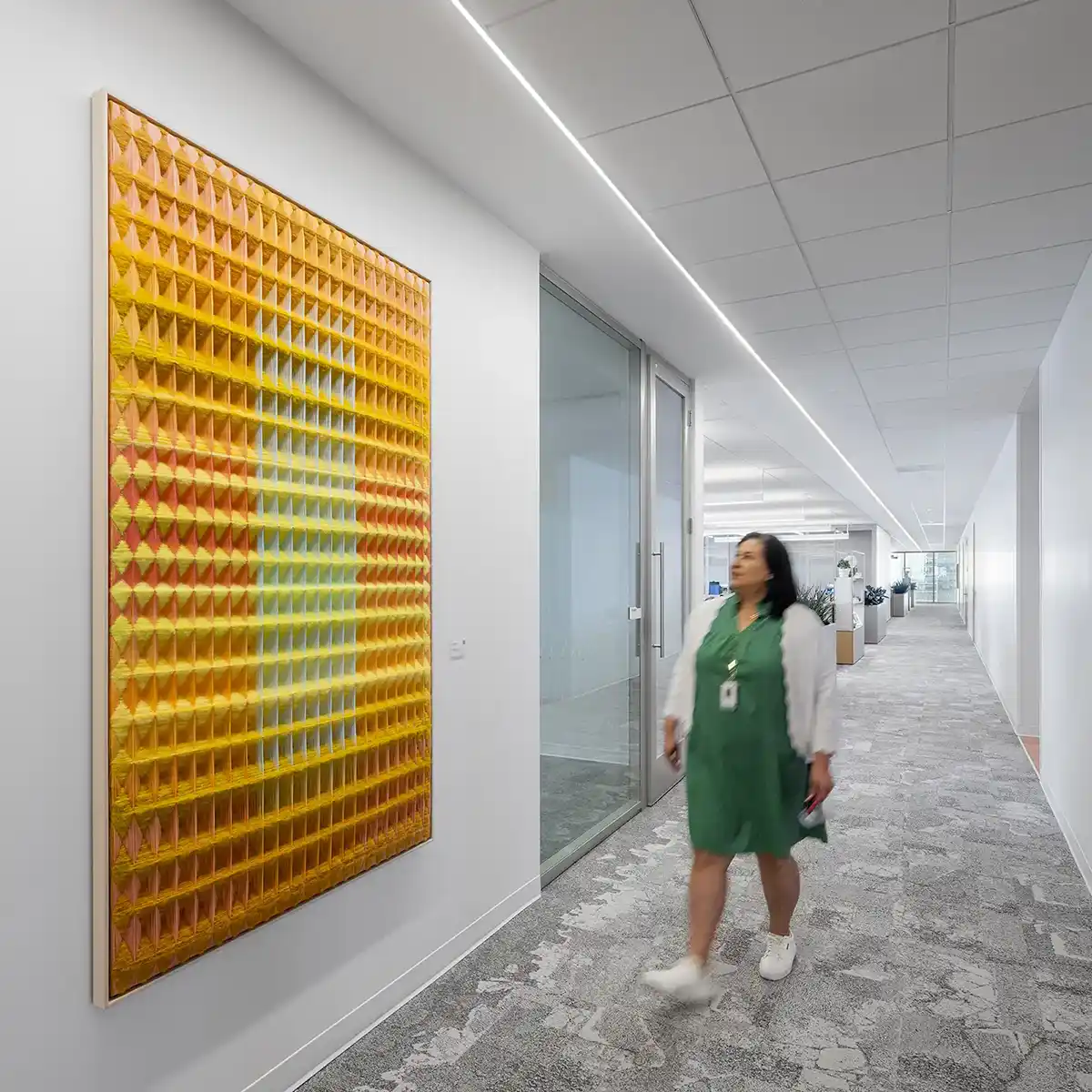
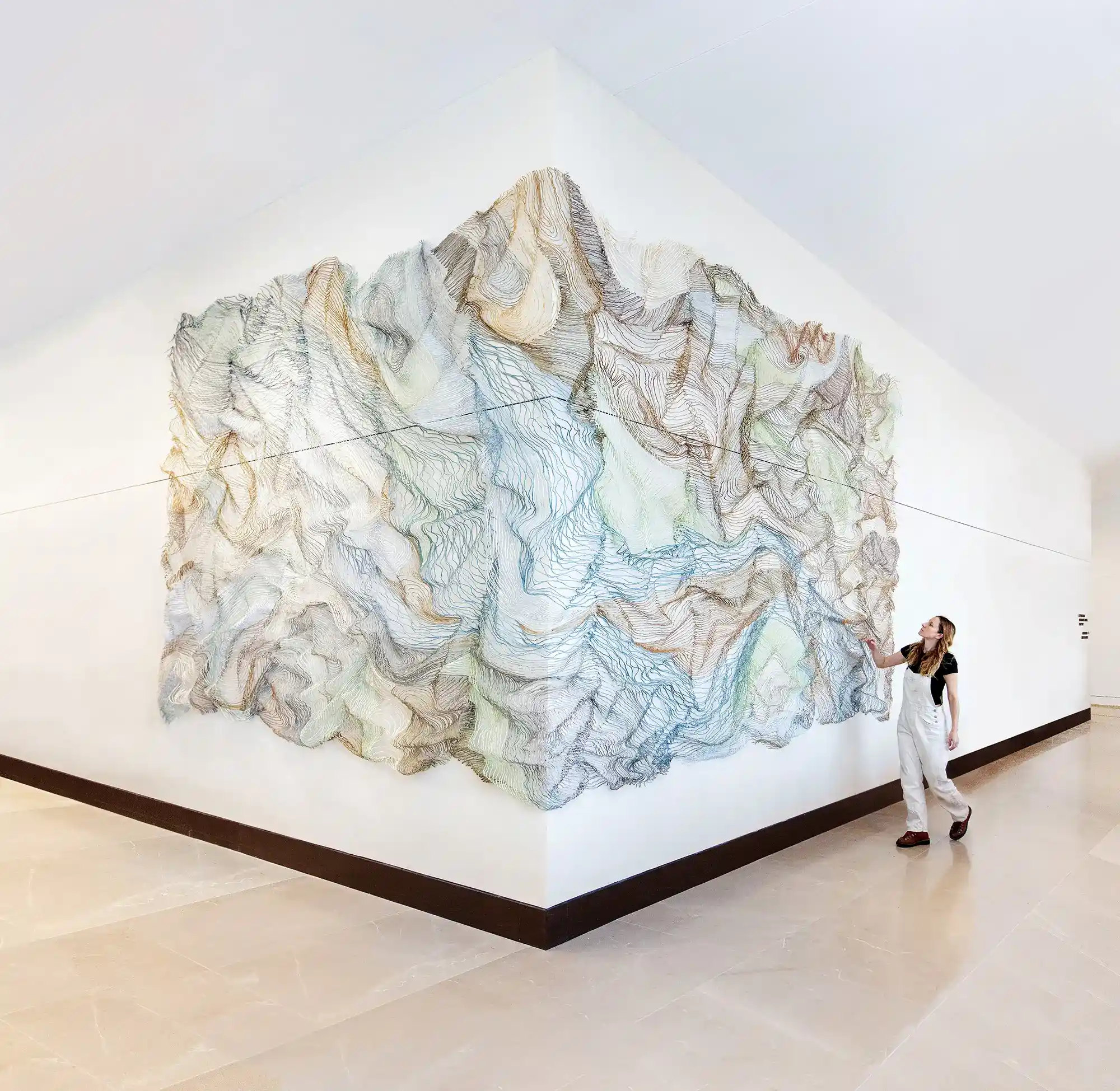
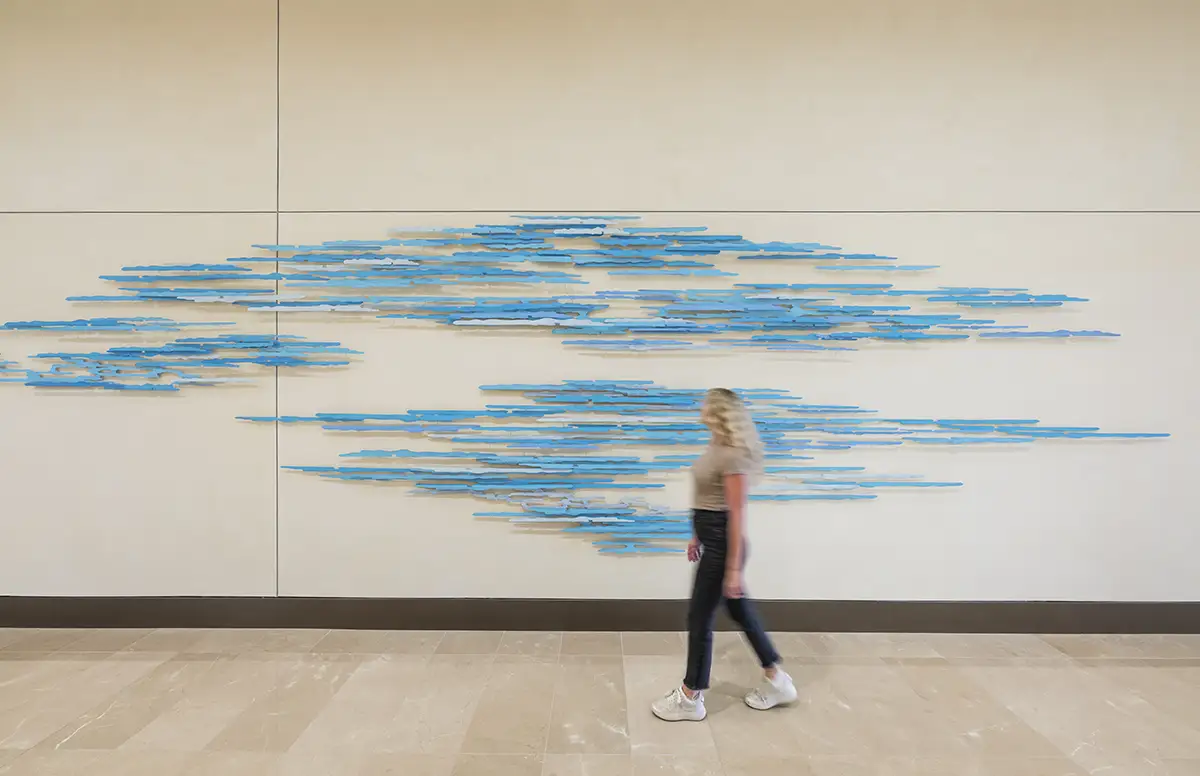
Artwork in the lobby at TIAA captures attention by using canvas, color and light to blur the boundaries between traditional painting and three-dimensional sculpture. Art consulting by Art + Artisans.
Jennifer Brener Seay (JBS): I’m interested, Wendy, to hear how workplace experience has evolved in your years in the field. It’s much more in the forefront of corporate leadership’s minds now to craft something that addresses employee comfort and wellbeing.
Wendy Waite (WW): Since COVID, it has really become the focus. For example, right before the pandemic, TIAA said, “We’re not doing any more remote work. That’s it. Love it or leave it.” Then COVID hit and, suddenly, everyone had to work remotely.
WW: Also, because of the impact the pandemic had on everyone’s health, there was really a focus on ensuring associates could be at their best whether psychologically or physically, in the office or working remotely.
WW: Now, with the waxing and waning of hybrid approaches, companies either mandate attendance so employees are left asking, “What are you doing for me once I’m here?” Or companies aren’t mandating it and leadership needs a genuine pull to get employees in the office, beyond the usual buzzwords of “collaboration and camaraderie.”
WW: The other thing, too, Gallup says that global employee engagement dropped to 20% in 2025. Which is the lowest point since 2020. So, even if associates are coming into the office, what is their engagement level when they’re there? Companies are realizing it’s about the environment employees are exposed to and how it supports their productivity and wellness, and how that effects the bottom line. It’s been a focus the last 5 years, and I would say the last 2 years, it’s been more of a push. I keep on hearing about it more and more.
Global Employee
Engagement
in 2025
Gallup, State of the Global Workplace 2026
Waite’s perspective isn’t just theoretical—it comes from years inside corporate real estate transitions. After pivoting away from law and commercial mortgage origination, she moved into corporate workplace strategy at Bank of America. There she helped manage projects like the 2MM sq. ft., 55-story Bank of America Tower at One Bryant Park, the first LEED platinum skyscraper in the US.
JBS: Tell me a bit about how your professional background shaped your approach to the physical environment.
We were hearing “digital-first” constantly, and while we need AV and laptops, we are human beings who need analog moments.
WW: I think the most significant experience was working on sustainability goals for the Bank of America Tower. We worked with a company called Terrapin Bright Green to focus on the triangulation of health, wellness and workplace and how they impact a company’s bottom line. So that’s really what started my interest in how a workplace can impact associates and their performance.
WW: Around 2018 is when everything started taking off regarding how we could layer in health and wellness, of which art plays a part, with sustainability. We were hearing “digital-first” constantly, and while we need AV and laptops, we are human beings who need analog moments. I was working at TIAA by then and our mission aligned with the idea of employee wellbeing, which made it easier to build a business case for adding those tangible human elements, like plants, natural light, and art, directly into the project budget.
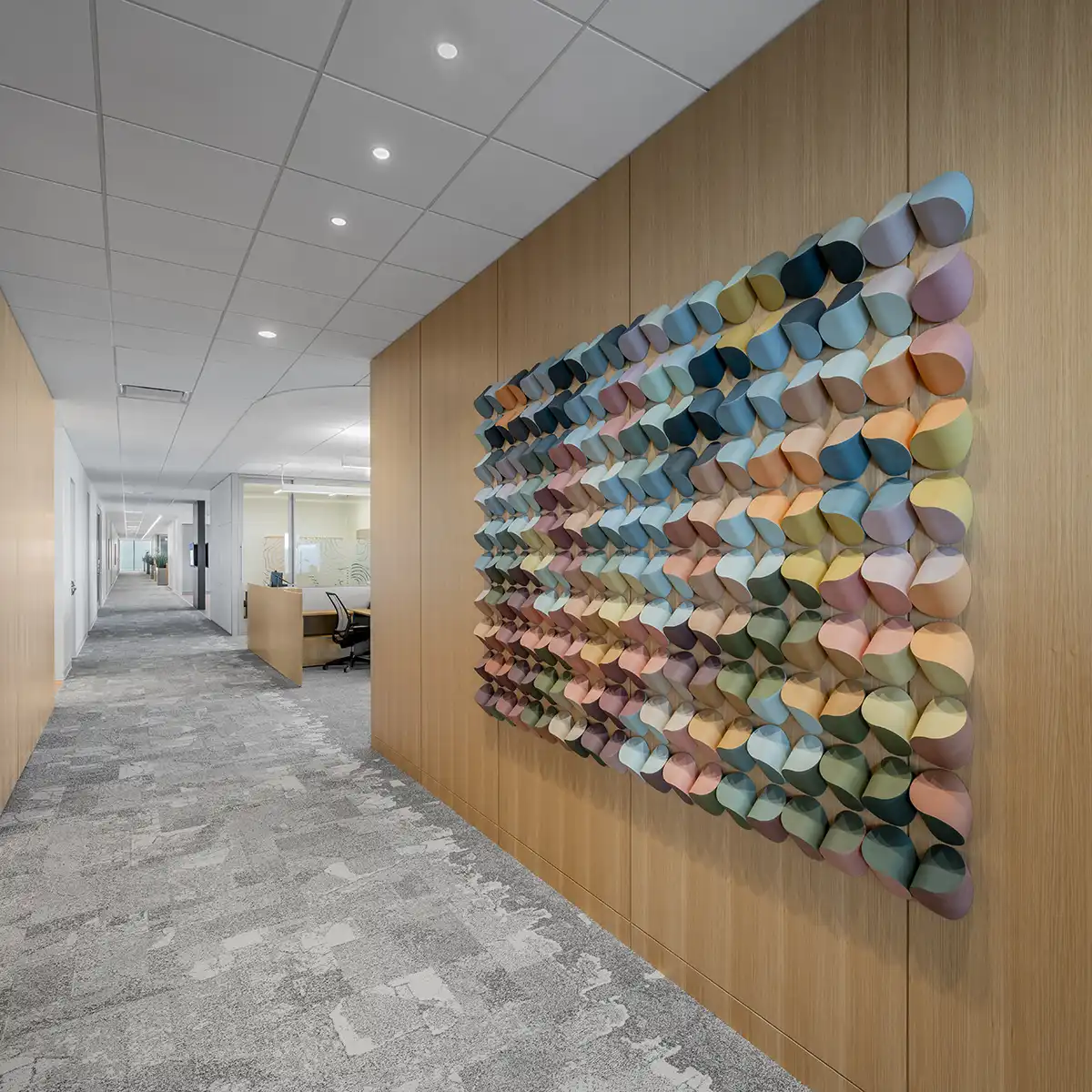
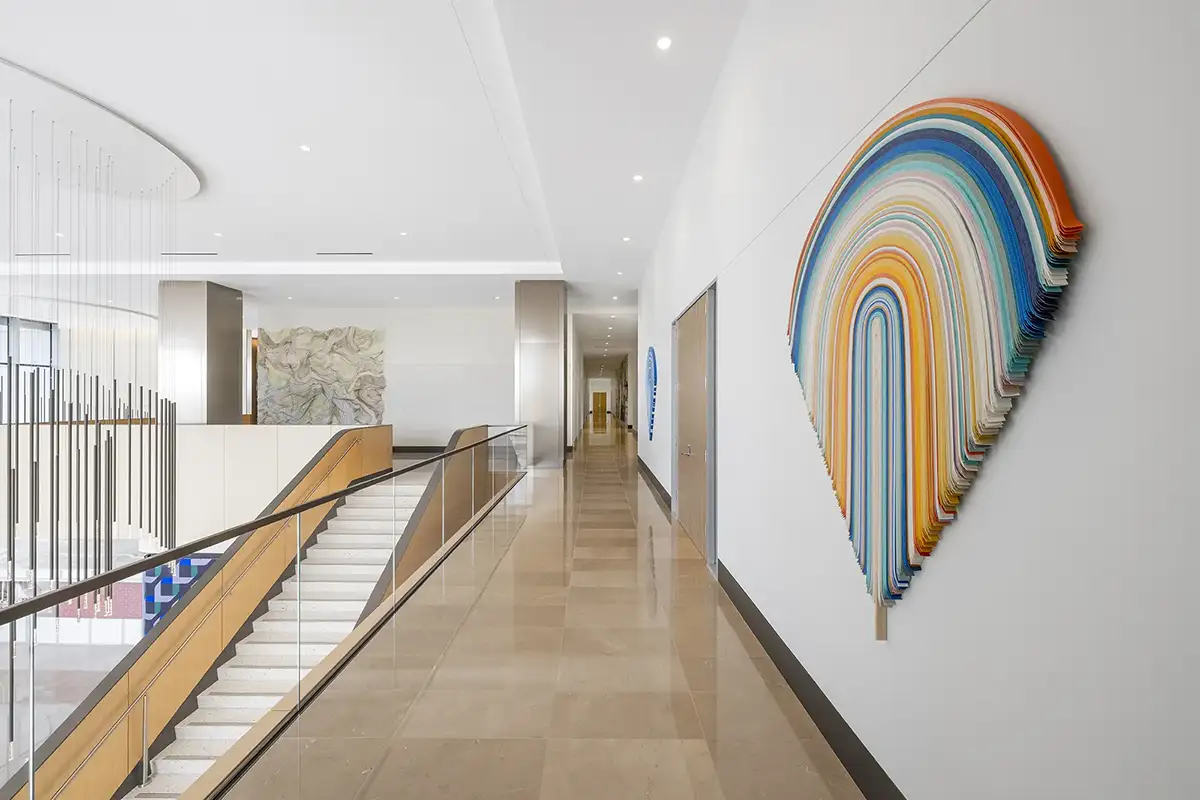
Artwork made of colored porcelain hangs in a corridor at TIAA. Art consulting by Art + Artisans.
The Economics of Art: Line Items, Benchmarks, and Buy-In
While executive leadership usually agrees with the idea of employee wellbeing, if you want to translate an idea like “analog moments” into a line item for art in your project budget, Waite recommends figuring out a dollar amount per square foot. Having someone to advocate for art at the beginning of the project is also crucial.
JBS: Is that when you think it’s most effective to start talking about integrating art? In those early budgeting conversations?
WW: Very early. If you don’t get a line item in the construction budget early, you won’t succeed. Even if it’s an estimate, providing a dollar-per-square-foot baseline puts art on leadership’s radar. Then you can shift it up or down as need be.
WW: In construction projects, it’s always easier to take things out than to add them later. Having buy-in from an executive, like a Chief Human Resources Officer who agrees with all the points of why art’s needed in the budget, is also very important and helpful to getting that line item secured.
If you don’t get a line item in the construction budget early, you won’t succeed.
JBS: How did you establish what that dollar amount should look like?
WW: A lot of trial and error. Service providers like CBRE, JLL, and Cushman & Wakefield publish white papers outlining benchmark construction costs per square foot for items like furniture, MEP, or fixtures. But that data doesn’t exist for art programs. It would be so beneficial if we could find an organization to help us establish a ballpark. And I really recommend using the dollar per square foot benchmark and extrapolating that out. Because that’s how construction teams work.
JBS: One baseline we often see in public sectors or universities is allocating 0.5% to 2% of the total construction budget directly to artwork. The challenge is deciding how to spend it. You could spend a $100,000 budget on a single statement piece in the lobby or spread it out with prints throughout the associate floors.
WW: Yes, and that’s what the project team needs to provide to you. They need to say, “This is where we want to spend our money.” They need to understand internally, from leadership, if the goal is one major wow moment at the front door, or if they want to distribute the budget to surround associates with smaller pieces of art where they actually work every day.
WW: And we had those discussions with our leadership during the project you did with us for TIAA. You know, “This is what we’re getting for our budget.” We even went back and bumped up the budget for the exterior art after we realized the impact we needed to make there. So, we ended up with an exterior budget that matched the interior budget, and we got approval to add the additional pieces around the building.
JBS: It’s really important to align on the goals of the art and understand where you want those artistic moments to be and then make sure that the budget makes sense to be able to reasonably meet those goals.
Value Engineering an Art Budget
In an ideal buildout, art is planned from day one. In reality, project teams often discover late in the process that art isn’t in the budget, but Waite says there’s still hope.
JBS: What happens when someone is already mid-project and missed that initial budgeting window?
If an architect specs a drawer pull or premium tile and the GC finds a comparable alternative at half the price, those savings can be reallocated directly to fund art.
WW: You look for trade-offs through value engineering. Design teams and general contractors constantly audit specs line by line, comparing everything from hardware pulls to floor tile. If an architect specs a drawer pull or premium tile and the GC finds a comparable alternative at half the price, those savings can be reallocated directly to fund art. Alternatively, teams can tap into facilities budgets or submit a business case to leadership for a scope adjustment. It takes a lot of time, but if an internal advocate is at the table pushing for it, the funding can often be found.
Curating Art for Representation, Inclusivity and Belonging at a Large Company
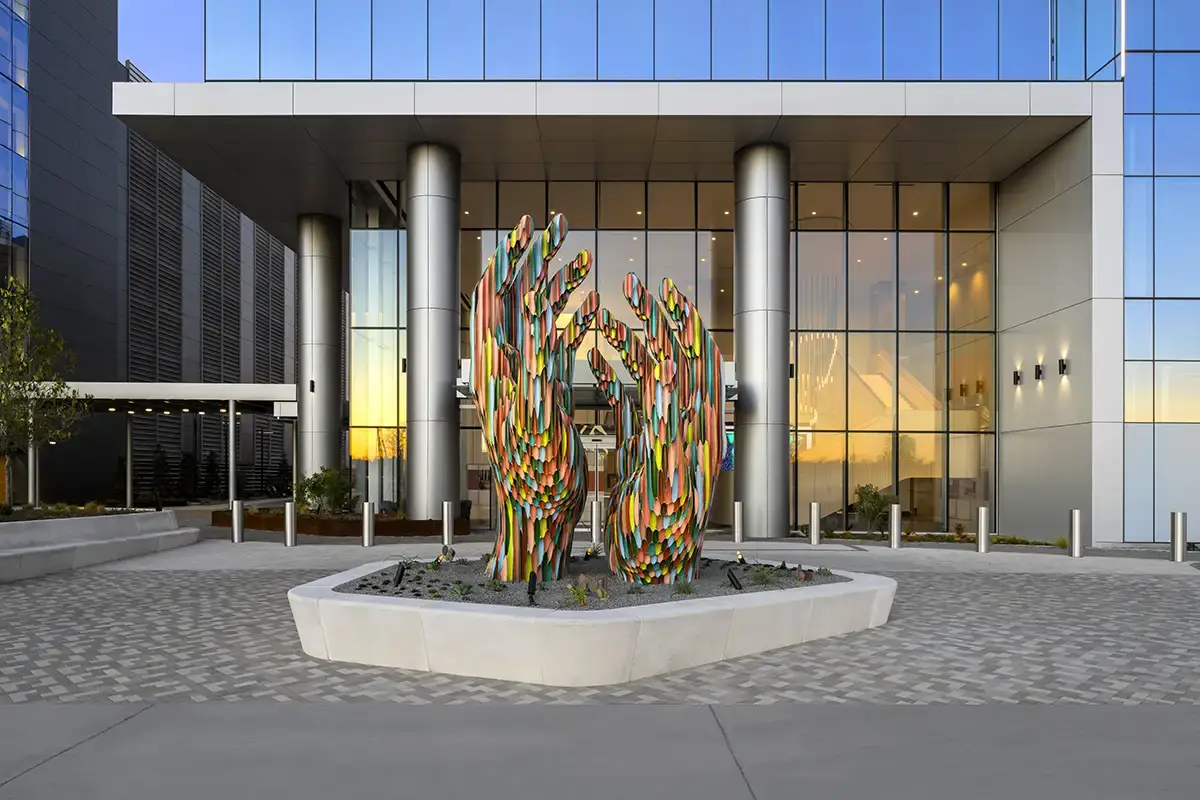
A massive sculpture of a pair of hands made of “colored pencils” in front of TIAA’s Frisco tower represents the company’s client base of educators and non-profit workers. Art consulting by Art + Artisans.
The benefits of using workplace art to help promote inclusivity and belonging while also representing organizational values is well documented. Waite spoke to us about how she accomplished this at a large company like TIAA with a diverse array of stakeholders.
JBS: I know that the murals at TIAA were focused on fostering a sense of belonging and inclusivity for employees as well as representing company values. I’d love you to speak about how you accomplished that.
WW: It starts with engagement. We brought in our marketing department who were aligned with HR. They knew right away they wanted to typify the mission and values of TIAA in the murals.
WW: We also talked with associates from our business resource groups, which represent different members of our workforce from common backgrounds like veterans, young professionals, individuals with disabilities. And we talked about what kind of art they wanted to see to make sure the imagery reflected our actual community. The golden rule for stakeholders was, you have a voice, not a vote. Which ensured broad participation but still kept the direction cohesive.
A Hospitality Vibe at Work
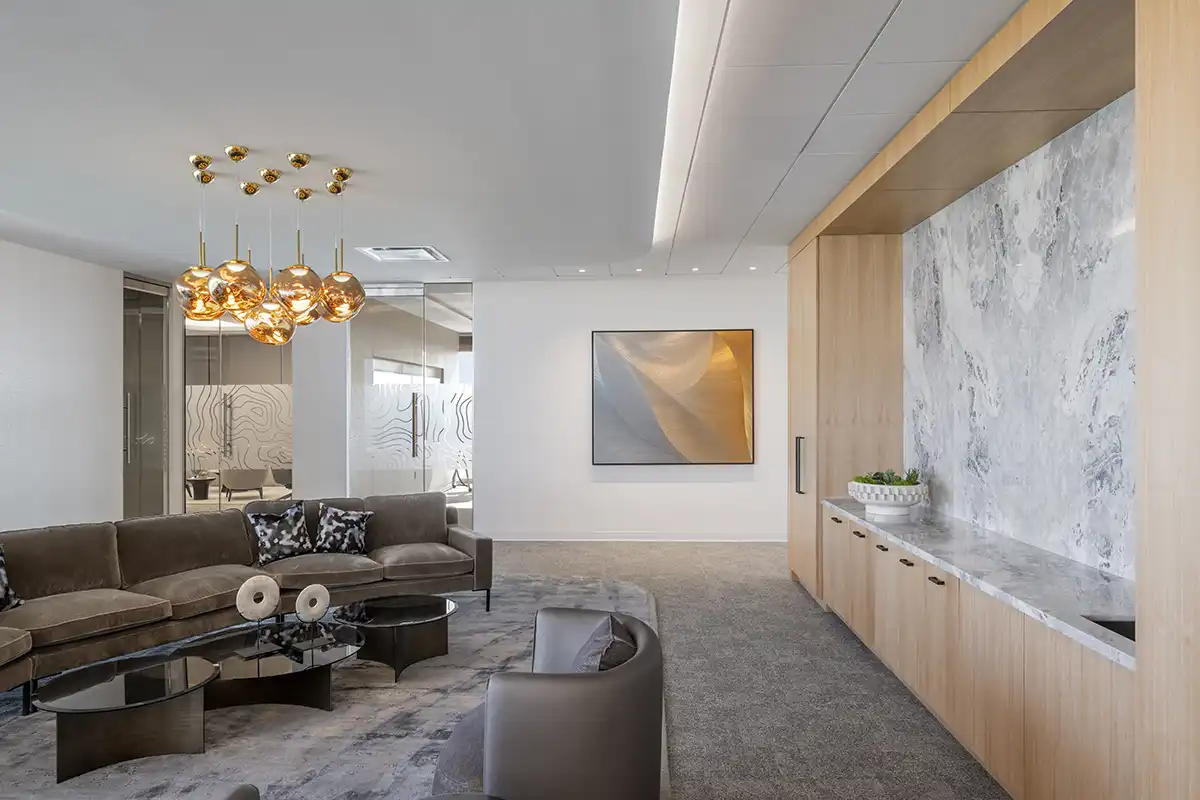
Waite and her team at TIAA incorporated fixtures, finishes and furniture that bring a “hospitality vibe” to the workplace. Art, natural light and plants add “analog moments.”
JBS: You spoke a little bit before about employees wanting their wellbeing taken care of. How can art serve as that magnet to pull employees back to the office while helping them feel more engaged and productive in a space?
WW: We can’t necessarily compete with the home office because, at home, you have everything custom-tailored to you and it’s 10 steps away. You’re not necessarily going to have that level of personalization at the workplace. So how can we amp up the workplace to resemble more of a hospitality vibe? That vibe you get when you walk into a hotel and have that concierge service?
WW: So, we had that concierge feel with workplace services. We incorporated fixtures, finishes and furniture that resemble the more natural, comfortable furniture you find in hotels.
WW: And we provided the analog moments like plants, water, art. We had all that in the workplace to make sure associates really enjoyed the space they were coming back to. And I think that’s what companies are amping up now to try to ensure that associates have that hospitality feeling as soon as they walk into the space.
JBS: How did the art help provide those analog moments?
WW: In areas of the floor that were supposed to be digital-free, or on the quieter side, we matched the art with the activity that was going on in the space:
- High-Energy Commons: Vibrant, engaging pieces that encourage conversation near pantries and cafes.
- Digital-Free Sanctuaries: Calming installations paired with plush textures, acoustic drapery, and greenery in quiet zones with no laptops or phones.
Measuring the Impact of Intentional Art
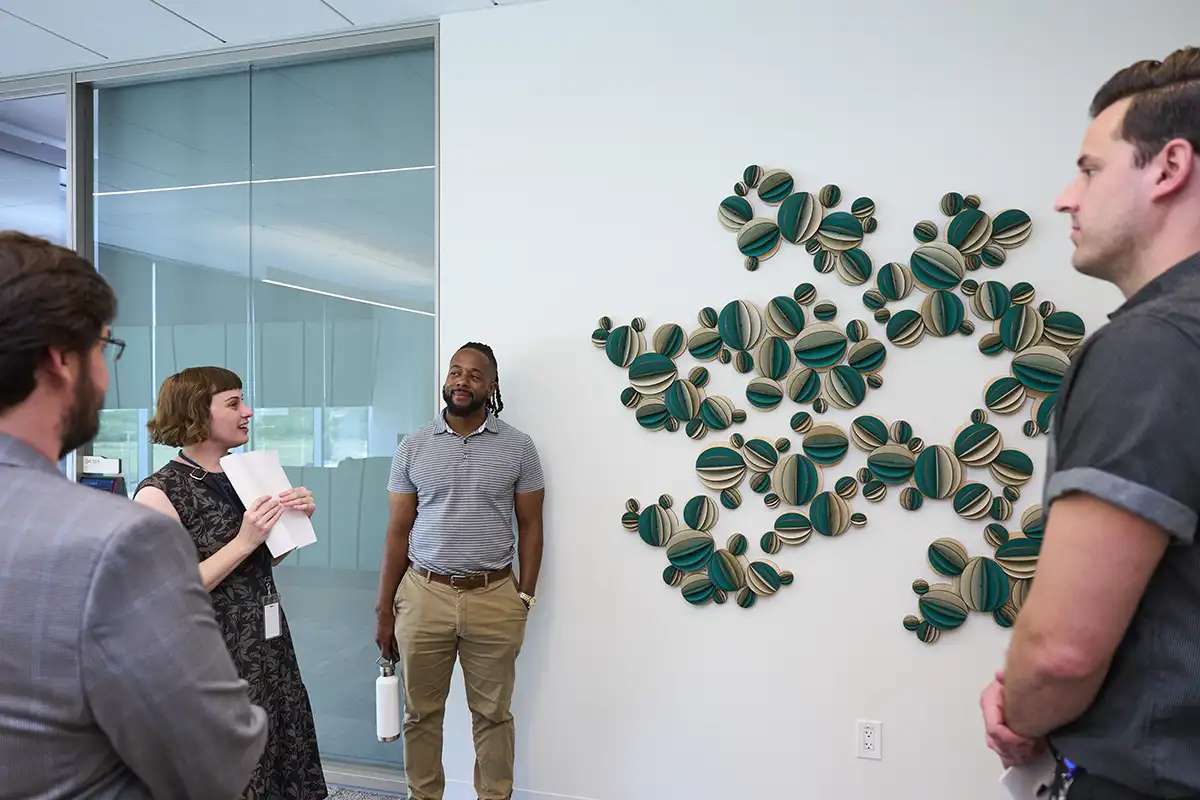
Gallery: Associates at TIAA show consistent engagement around specific art installations.
Proving the return on investment (ROI) for workplace design is notoriously nuanced in corporate real estate. While retail or commercial leasing can point to sales and foot traffic, internal workplace ROI lives across employee sentiment, health metrics, and cultural adoption.
JBS: Once people moved in and lived in the finished space in Frisco, how did all of that thoughtful design and art affect their mood, stress levels, and overall well-being?
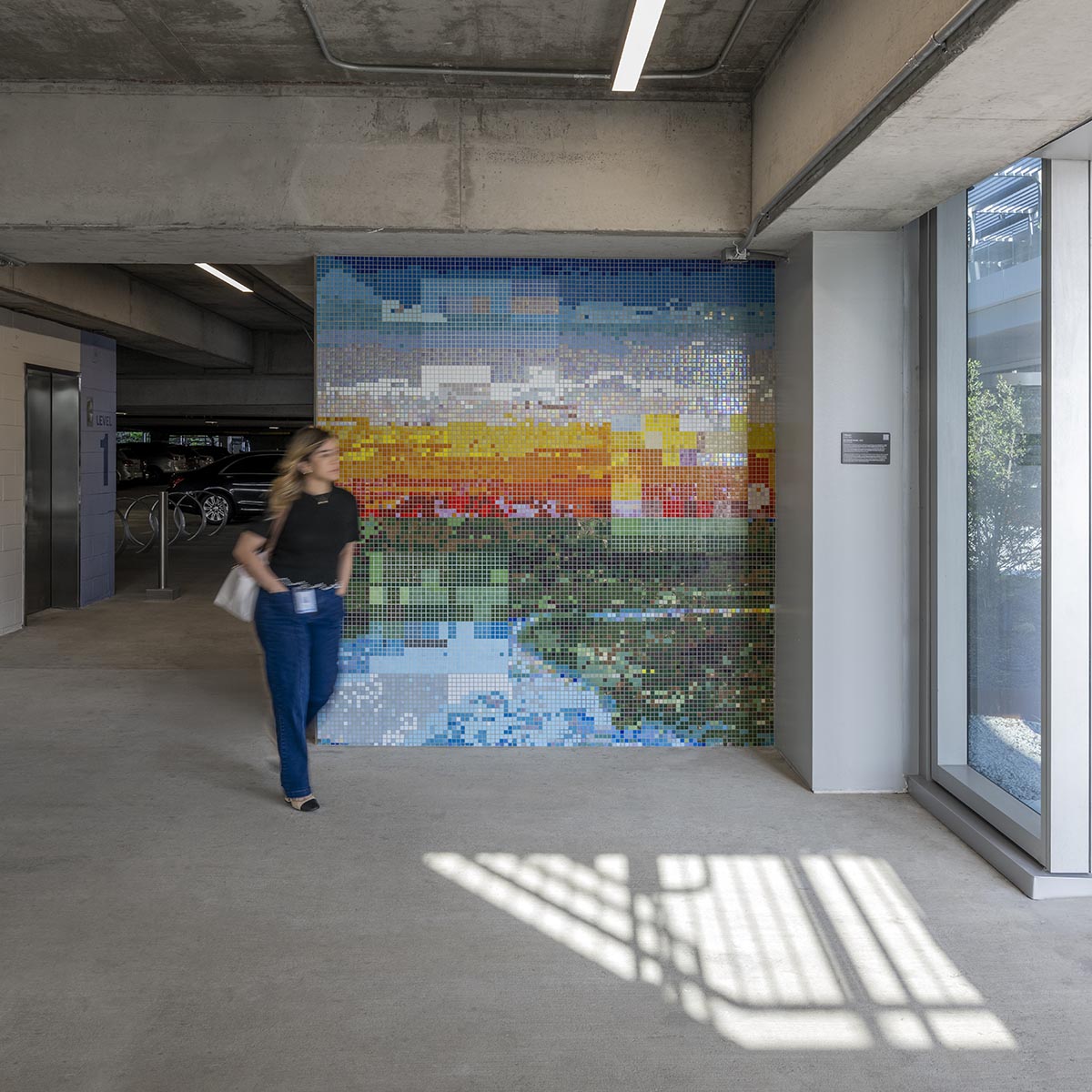
WW: You could see the excitement immediately. People actively chose desks near their favorite pieces so they could look at them during the workday. We also saw consistent engagement around specific installations. The hands sculpture outside became a popular piece to photograph. We saw people stop and play with the kinetic pieces. And the mosaic in the parking deck gets a lot of attention because employees actually helped create it during our opening events.
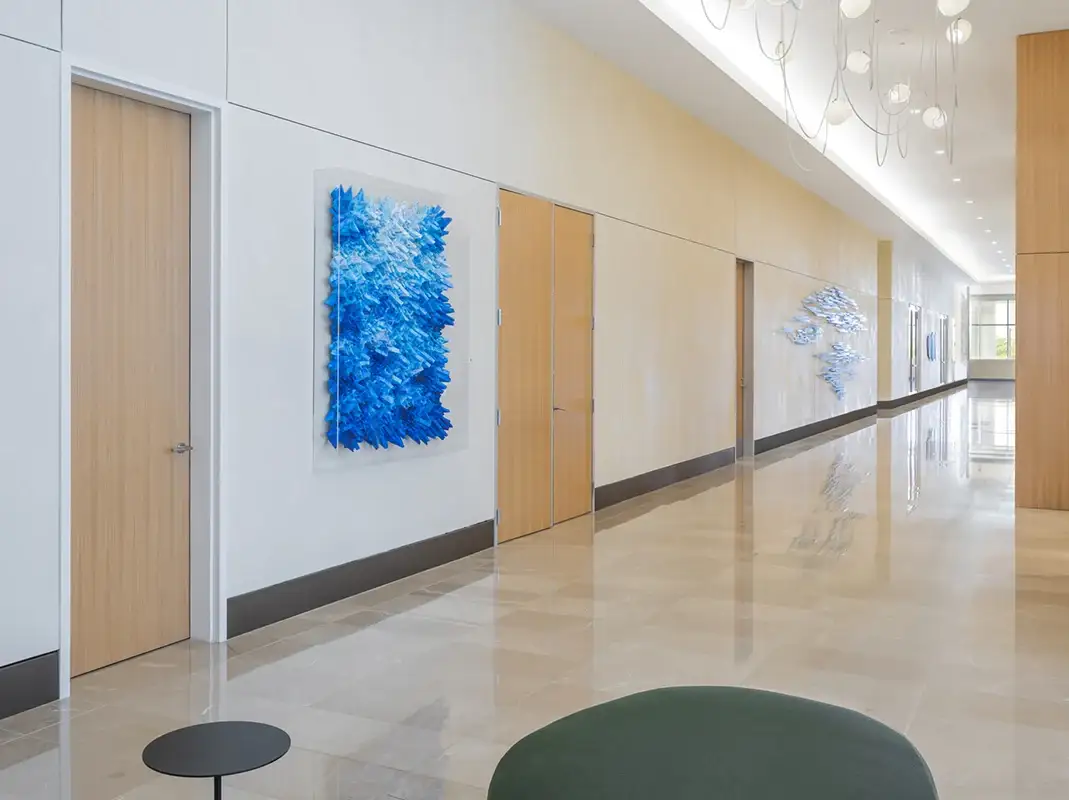
WW: I actually think people are transfixed by the art along that entire corridor on the second floor, when you walk from the stairwell all the way down to the large conference center, because of the height of the ceiling. The art adds so much movement and so much character to a corridor that could be really boring.
JBS: It really is like a whole gallery being in there.
“I actually think people are transfixed by the art along that entire corridor on the second floor,” Waite says. “The art adds so much movement and so much character to a corridor that could be really boring.”
JBS: How did you evaluate and communicate that ROI back to the executive team?
WW: We tracked it through a combination of change management meetings and post-occupancy surveys. We also knew it succeeded when leadership all the way up to the C-suite noted how different and un-corporate the space felt, especially with the higher-end sculptural pieces in the executive suites.
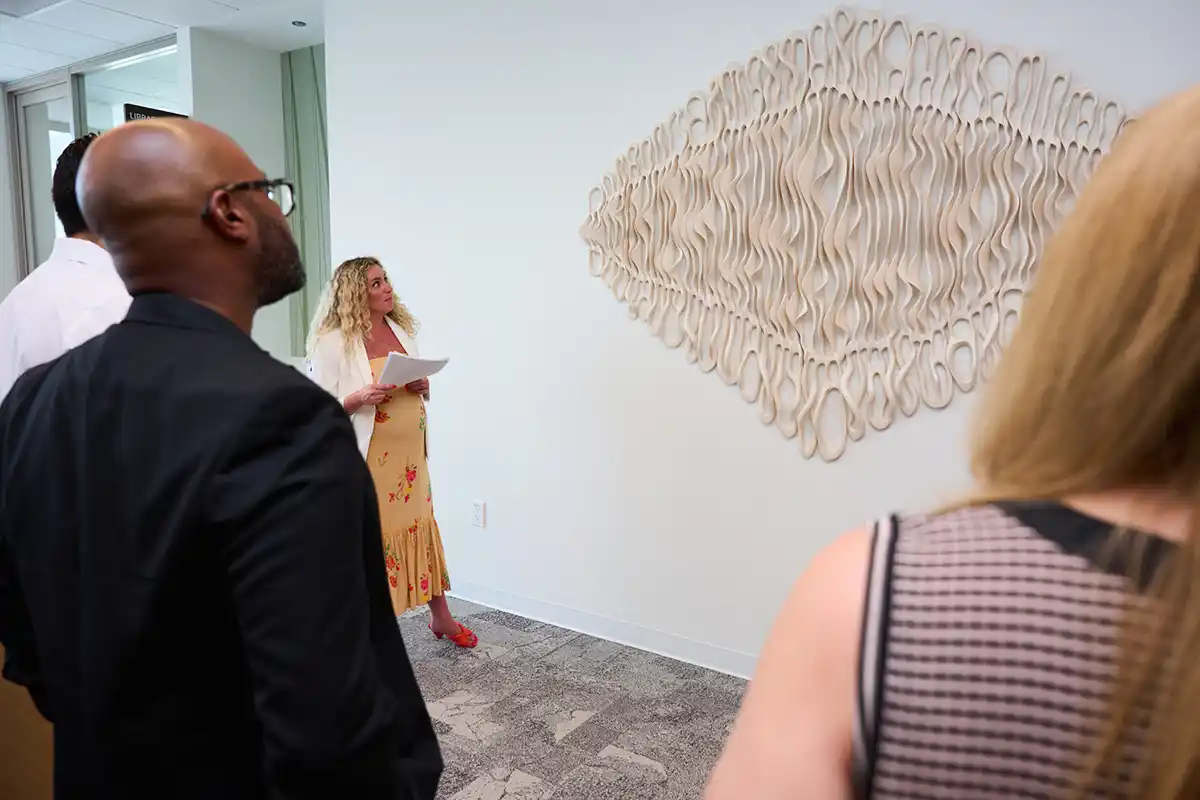
External interest became its own metric. Having outside organizations and industry groups request tours just to see the art program provides immense external brand and marketing value for a company.
WW: Beyond internal metrics, external interest became its own metric. Having outside organizations and industry groups request tours just to see the art program provides immense external brand and marketing value for a company. When a space is designed well, people feel the lift physically the second they walk through the door—and leadership stops asking you to justify the spend and simply says, “Do more of this.”
Gallery: TIAA employees receive a guided art tour on the opening day of the new Frisco office tower.
JBS: Where do you look for ongoing inspiration to keep workplace experience feeling relevant?
WW: I lean on my sustainability background a lot. I have my WELL AP and my Fitwel. So I think about health and wellness first. What associates need in a workspace whether it’s acoustic, lighting, views of nature. But I’m also an art nerd. I love bringing in elements of contemporary street art, like mosaic work, to keep an established brand feeling modern. When you can link those tangible, analog moments directly to psychological wellbeing, leaders can’t get enough of it. They see the impact, and rather than asking you to justify every piece, they just want more of it.