

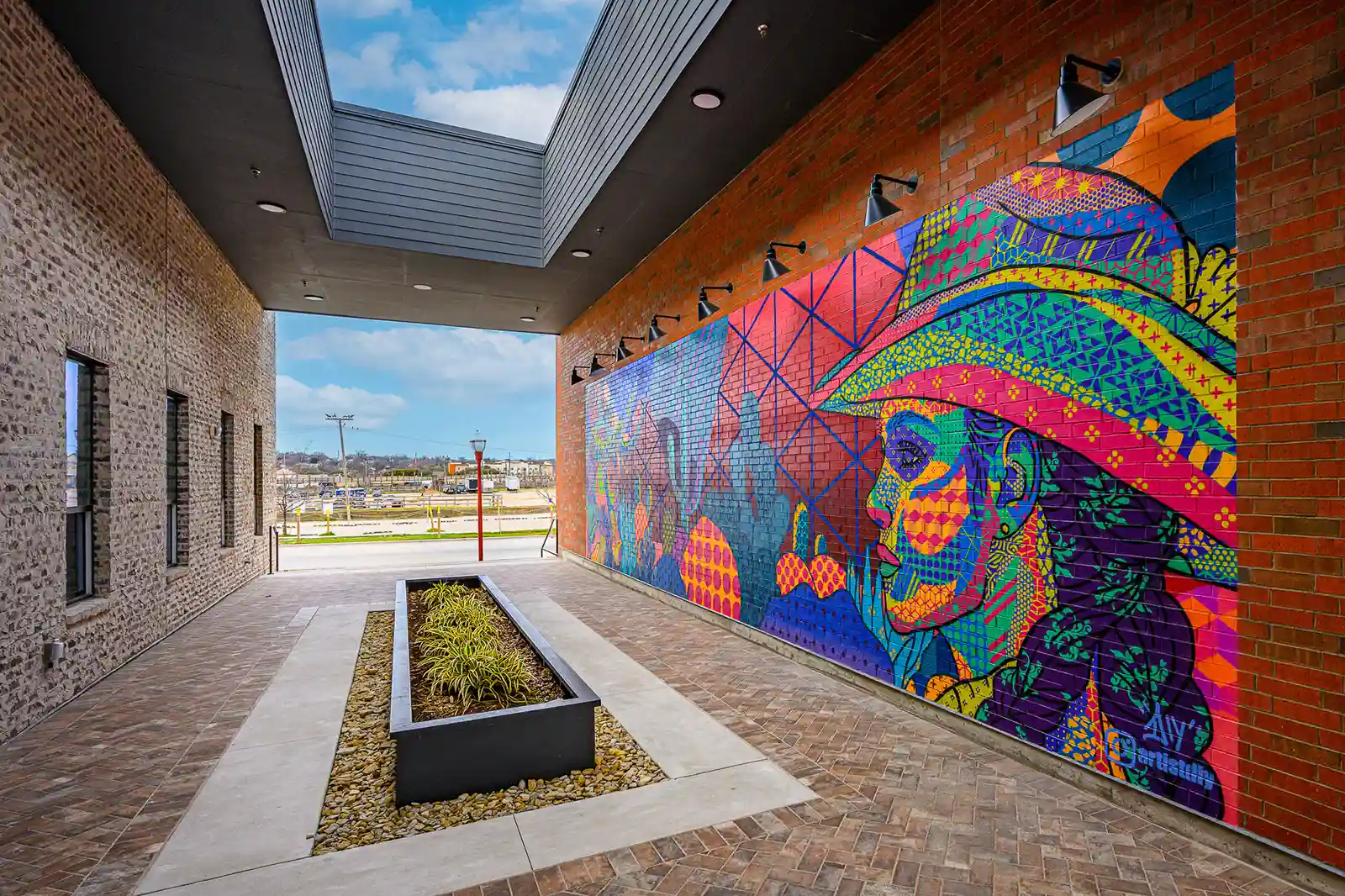
Commercial art budgets often run out of money for impactful art like this vibrant outdoor mural located in the Ft. Worth Stockyards District at The Union at Stockyards apartment complex. Art consulting by Art + Artisans. Photo by Mike Healey Photography.
It’s a common scenario. A commercial build-out is near completion. The drywall is painted, lighting is installed, and furniture has been purchased. That’s when the client says, “What about art?” The project team turns to procurement only to realize there’s not enough money left in the FF&E budget for art worthy of the building’s class-A design.
How does the elevated aesthetic promised in early concept renderings devolve into blank walls? It’s not because custom art is inherently unaffordable. It happens because of a single structural flaw in the way most commercial project budgets are created.
Read on to learn the #1 reason commercial projects accidentally deplete their art budgets. Plus, find out the simple budgeting shift that gives you access to high-impact art without project headaches.
Burying Art Inside FF&E is the #1 Way to Lose Your Art Budget
The #1 reason commercial art projects run out of money is because the funding gets buried within the budget for furniture, fixtures and equipment (FF&E). Artwork is usually the final installation phase delivered to the site so project teams avoid planning for it until late in the project. This leaves it vulnerable to every overage that comes before it. By the end of the project, art has been inadvertently value-engineered down to uninspired pieces, or walls are simply left blank.
Shared Budgets Always Sacrifice Art First
In commercial development, the budget line item for FF&E is an umbrella category designed to absorb hundreds of individual interior items. When artwork is grouped into this general pool, it’s placed in direct financial competition with essential operational assets like workstations, seating, and conference tables.
A business cannot open its doors without desks, chairs, and functional meeting rooms. It can, however, operate with blank walls. Because core furnishings are non-negotiable for daily operations, the flexible items inside the FF&E bucket, like art, naturally absorb the shortfall. The art program becomes an informal contingency fund for the rest of the interior scope, drained penny by penny before art procurement even begins.
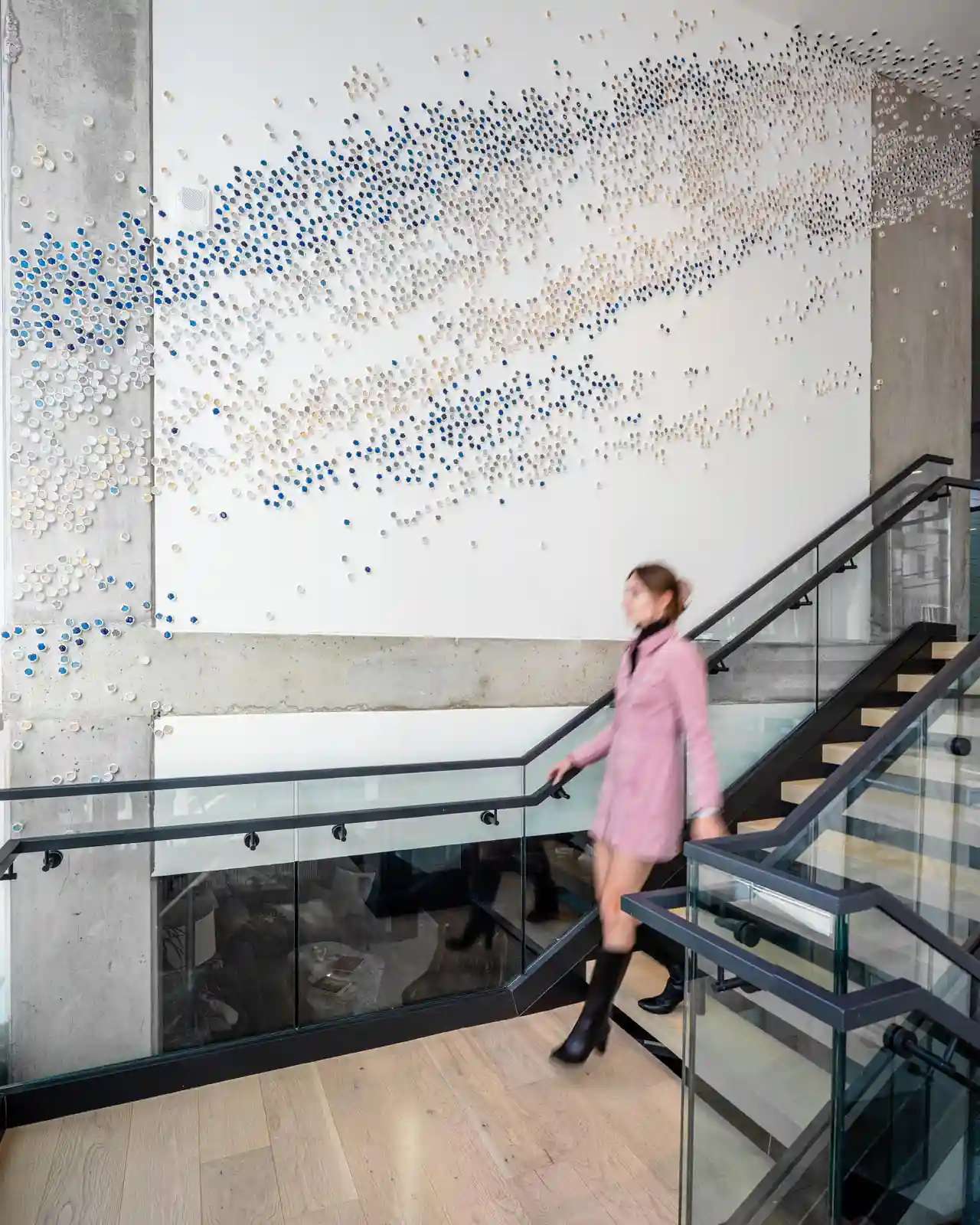
When art is planned early, it’s more thoughtfully integrated into architecture and interior design like this wall installation at Austin luxury student living tower Villas on Rio. Art consulting by Art + Artisans.
The Flawed Mindset of Treating Custom Art Like Office Furniture
Assuming Impactful Art Can Be Bought from a Catalog
Burying artwork inside an FF&E budget reflects an underlying industry misconception: that artwork is an off-the-shelf commodity selected from a catalog, loaded onto a truck, and hung on a wall the same way a desk is placed on the floor.
Design and construction professionals understand that elevated architectural finishes can’t be ordered off a shelf at the eleventh hour. A signature art program requires the same kind of forethought as custom millwork or ornamental metal. Below are some of the details to consider when planning for art that’s intentionally integrated into the design of the property.
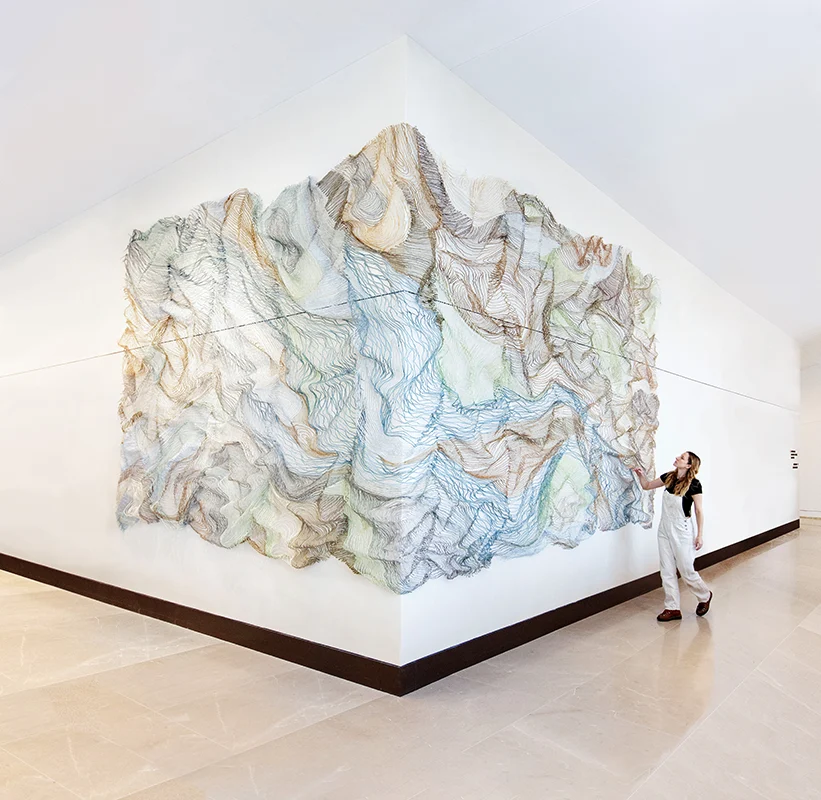
A wall installation at TIAA’s office tower in north Texas. Art consulting by Art + Artisans.
The Result of That Assumption: Two Bad Choices
When project teams leave art planning until punch lists are circulating, turnover deadlines are approaching, and walls have already been taped and painted, they’re forced into a frustrating dilemma.
- Settle for Low-Impact Prints in Key Focal Areas: To avoid reopening finished walls, the team can resort to hanging off-the-shelf framed prints under flat commercial lighting because that’s all that can be supported by basic drywall anchors. While quality prints have an intentional place in projects, using them in primary focal zones undermines the space, signaling an uninspired corporate afterthought on an otherwise Class-A build.
- Expensive Late-Stage Retrofits: If leadership insists on installing heavy dimensional pieces or illuminated art, the contractor must cut back into walls that are already finished, framed, and painted.
The Compounding Cost of Late Field Changes
Opening up finished partition walls creates an expensive cascade of charges across multiple trades:
- Subcontractor Trip Charges and Premium Rates: Framing, electrical, and painting crews have already packed up and moved to other jobs. Bringing them back requires paying trade trip minimums and premium labor rates to work out of sequence.
- Cutting Open the Drywall Means Repainting: You can’t spot-patch commercial drywall under bright window light without the patch showing. The wall must be cut open so structural backing for the art can be framed in, the opening re-taped, and the entire wall face skimmed to a Level 5 finish and repainted corner to corner.
- Damage to Other Installed Finishes: Moving ladders, power tools, and paint crews over newly installed carpet, polished concrete, or custom millwork risks surface damage just days before project turnover.
Waiting to plan for art until late in a build turns what should be a project highlight into an expensive, avoidable retrofit.
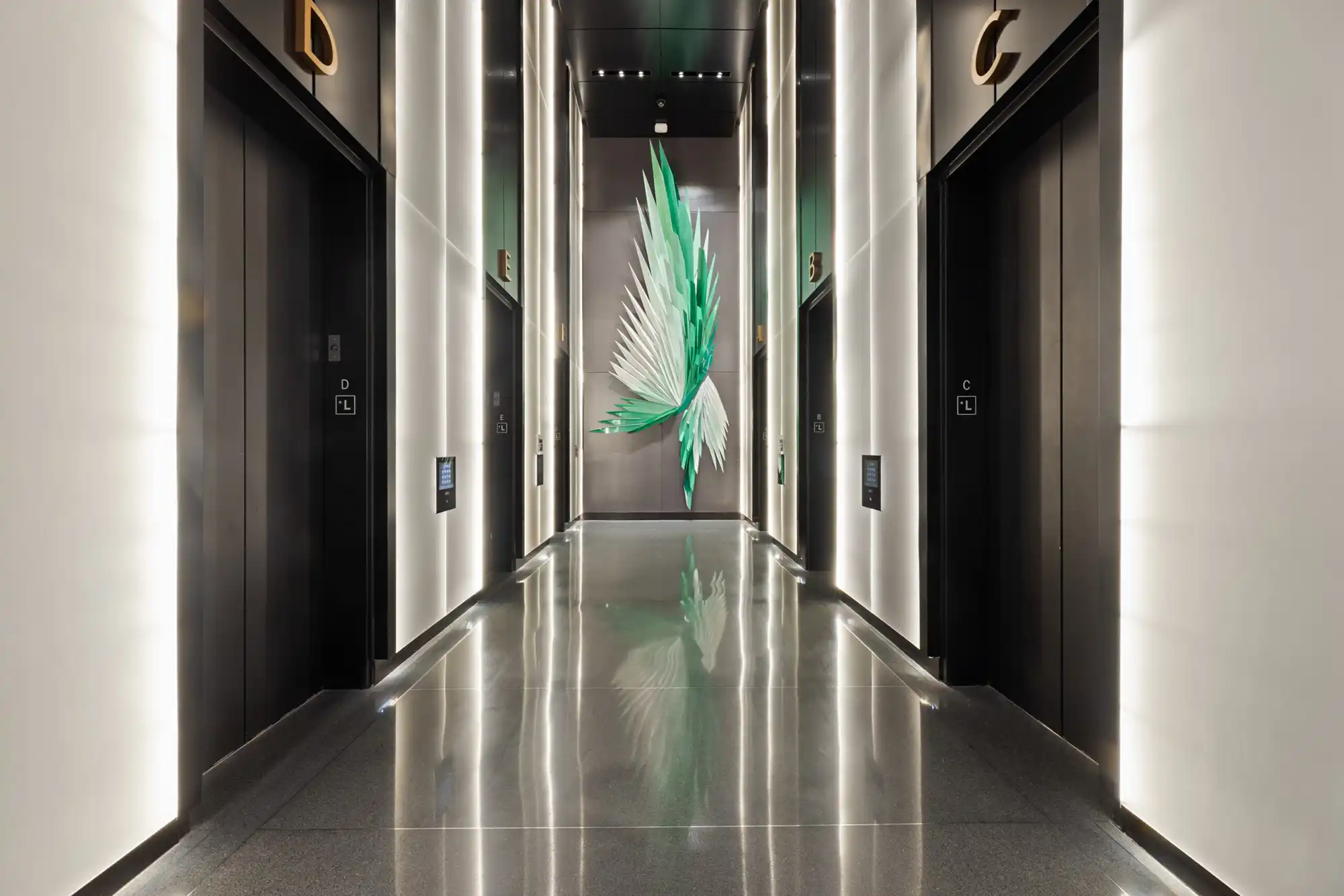
A 20-foot painted aluminum sculpture hangs in the elevator lobby of the office tower at The Quad mixed-use development in Dallas. Art consulting by Art + Artisans.
To Protect the Art Budget, Give it an Independent Line Item
Keep the art budget from turning into an unintentional contingency fund for every other overage by establishing its own line item from day one. This accomplishes three critical objectives:
- Insulates the Budget: It walls off funding so that trade overages, furniture price escalations, and contractor change orders cannot drain the art budget.
- Creates Accountability: Designating a line item for art creates a clear boundary between the design team managing interior finishes and furnishings, and the person directing the art program.
- Protects a Mandate: A separate art budget line item prevents leadership from viewing art funds as discretionary cash and establishes the art program as a planned investment.
Setting the Budget When You Don’t Know Where to Start
The primary reason most teams default to bundling art into FF&E is uncertainty about what it should cost. Commercial development teams know standard construction costs for developments of different sizes and scopes, but they rarely know what a cohesive, site-specific art package should cost.
This pricing ambiguity is also the first reason to bring an art consultant on board as early as possible. Rather than guessing at numbers, engaging an experienced art consultant allows you to benchmark a realistic budget based on the scale and goals of the project.
Client Education
Ask clients up front if they plan to incorporate art into their development or workplace buildout. Educate them about the importance of planning for art early. Just as it took a few years of client education to normalize early planning for green building and LEED certification, it will also take some education to normalize early planning for art.
Why the Art Consultant Belongs at the Table from Day One
Protecting the art budget is only half the battle. A budget allocation alone doesn’t manage the construction timeline, nor does it ensure you get the most for your money. Without someone knowledgeable actively driving the art scope from the beginning, busy project teams will continue to avoid planning for art while all their best options vanish. If they’re lucky, they’ll end up with enough funds to pay dearly for rush fees on art that isn’t their first choice.
This is why engaging an art consultant from the beginning of a project is so important.
When you bring an experienced art consultant on board to help you build a realistic art budget for your bid, it provides tangible operational, financial, and curatorial protections that save money and keep the build on track.
Qualified art consultants, like the ones at Art + Artisans, staff their teams with registered interior designers and LEED-, WELL-, and PMP-certified project managers who understand the daily pressures and technical priorities of interior design teams, general contractors, and trade subs. By speaking the language of construction and design, art consultants manage the entire art program end-to-end, so clients don’t have to worry about the details.
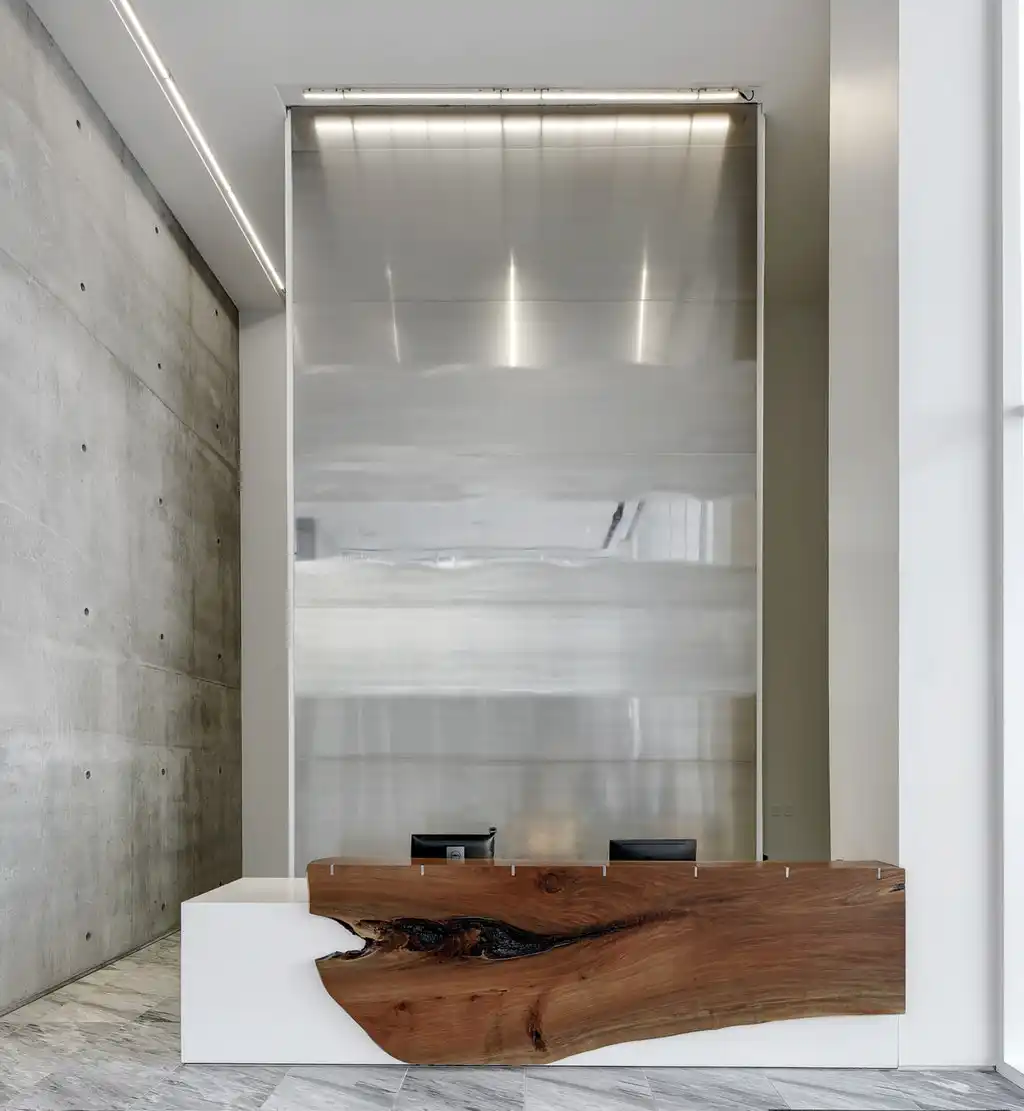
At The Independent Luxury Residential Tower in Austin, an aluminum sheet-metal art installation sits behind the reception desk in the lobby. Art consulting by Art + Artisans.
How an Art Consultant Establishes a Realistic Budgeting Framework
An art consultant eliminates guesswork during budget creation by translating project parameters into an accurate, defensible financial roadmap for your art program.
- They Start with What You Want the Art to Achieve: Before looking at numbers, an art consultant sits down with leadership to understand the bigger picture. Are you trying to attract top talent back to the office, celebrate local heritage, or provide quiet, restorative spaces that help reduce sensory fatigue? A lobby designed to turn heads and speed up leasing requires a very different strategy than a space meant to encourage reflection or creativity. Nailing down these priorities early keeps spending focused on what moves the needle most.
- They Evaluate Floorplans for High-Impact Locations: When an art consultant joins the project early, they can review preliminary architectural drawings to identify focal zones like main entrances, elevator banks, and shared lounges. Figuring out where custom installations are essential and where cost-effective prints are sufficient prevents overspending on secondary areas while ensuring signature spaces are funded to make an impact.
- They Balance Materials and Fabrication Realities: You cannot set a realistic budget without understanding the physical requirements of each medium. An art consultant pairs design goals with real-world fabrication and site costs. A framed print package only requires simple drywall anchors, but a multi-story mural demands surface prep and lift rentals, while heavy dimensional wood or fabricated metal pieces require structural wall blocking and specialized freight. Accounting for engineering, hardware, and shipping logistics from day one prevents unbudgeted soft costs later.
- They Lean on Real-World Experience: Art consultants can draw on their past projects to demonstrate to clients what it actually costs to fund an art package of similar scale. This provides reliable spending ranges so the development team neither over-allocates capital nor underbudgets for impact in high-traffic focal areas.
- They Know How to Adapt: A good art consultant organizes the overall art program into clear must-haves versus value-add tiers. If overall build costs fluctuate during schematic design, leadership has pre-vetted options to dial the scope up or down without cutting into the property’s core vision.
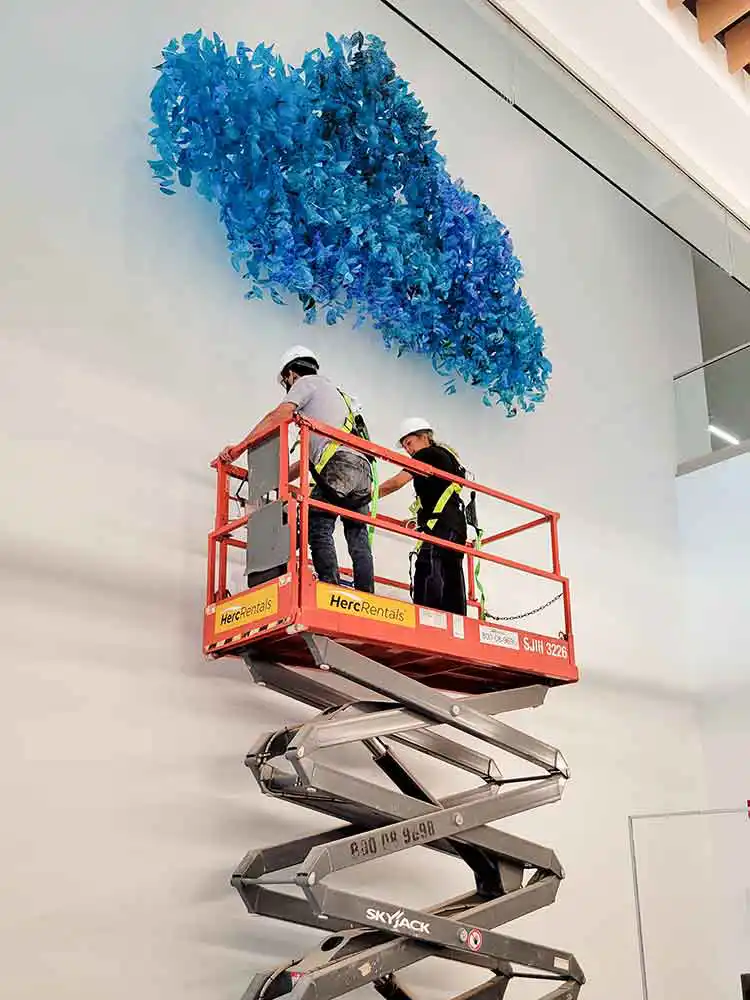
Art consultants oversee all art installation on the construction site. Image: A dimensional wall sculpture is installed at Austin Energy. Art consulting by Art + Artisans.
Handling Trade Coordination of the Art Package
Once leadership approves final artwork selections, the art consultant translates the physical dimensions and mounting requirements into clear coordinates for the construction team before trades close up the walls.
- Structural Wall Backing: They provide verified weights and mounting heights to the general contractor so framing crews can install wood or steel backing at minimal cost before drywall goes up, rather than requiring expensive wall cutting, patching, and repainting later.
- Conduit and Electrical Rough-Ins: They coordinate directly with the electrical subcontractor to rough-in recessed junction boxes and dedicated circuits behind digital artwork, illuminated installations, or video displays.
- Directional Lighting: They collaborate with the design team to ensure the reflected ceiling plan incorporates dedicated lighting fixtures for the artwork, providing proper throw distances and beam angles rather than flat ambient wash.
Ensuring Code Compliance and Risk Reduction
Commercial interiors are governed by strict life-safety, accessibility, and environmental standards that studio artists rarely encounter. An expert art consultant is trained in these standards to ensure all artwork and art displays are up to code.
- ADA Protrusion Standards: Art consultants trained in accessibility compliance audit dimensional wall installation plans to verify the artwork won’t project more than four inches from the wall plane, avoiding costly punch-list violations before final inspection.
- Life Safety and Egress: A qualified art consultant reviews art materials against commercial fire codes, including ASTM E84 Class A flame-spread ratings. They also confirm that textile or sculptural artworks do not obstruct fire sprinkler throw radiuses or emergency egress routes.
- Permitting and Engineering: For exterior installations, ground-mounted sculptures, or suspended atrium features, the art consultant coordinates wind-load engineering, seismic calculations, and required municipal permits with licensed structural engineers.
Overseeing Art Fabrication Schedules, Deliveries, and Site Installations
Custom studio commissions and large statement artwork usually carry 8- to 24-week lead times. An art consultant tracks art production milestones directly with the artists and custom framing studios, running their timelines in parallel with the overall construction schedule.
Because construction schedules frequently shift, the art consultant stays in close communication with the general contractor regarding actual site readiness for art delivery. If completion dates slip, they coordinate secure storage for the art until the display site is dust-free and ready for installation.
Once the site is cleared, the art consultant oversees the unpacking and installation of the art, ensuring every piece is mounted to exact specifications without sustaining damage from active trades or construction debris. Finally, they conduct a complete walk-through with the designated project contact, using the floor plan to ensure that everything is in place as agreed.
Setting Your Art Program Up to Win
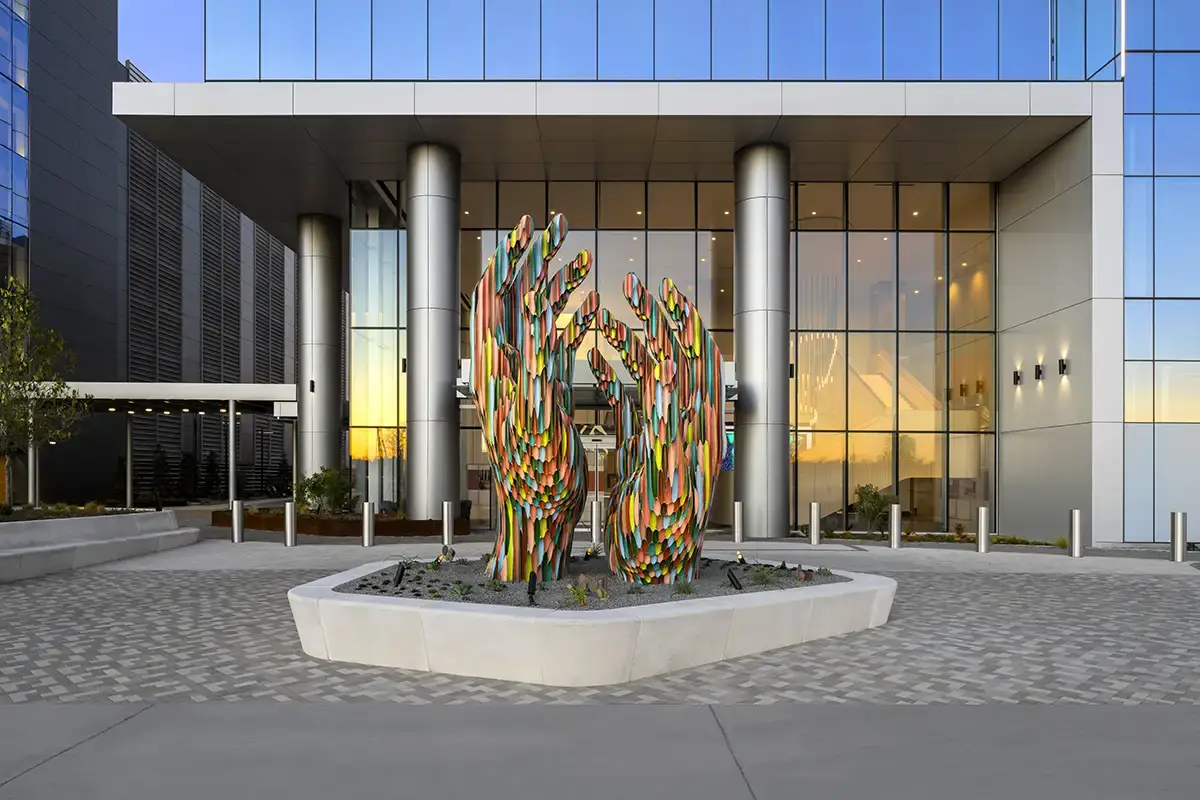
A massive sculpture of a pair of hands made of “colored pencils” in front of TIAA’s Frisco tower represents the company’s client base of educators and non-profit workers. Art consulting by Art + Artisans.
Executing a commercial art program requires the same pre-construction discipline as any other major trade scope.
Leaving art out of the initial plan or grouping its funding with FF&E almost always forces unnecessary compromises. By the time walls are taped and painted and furniture is arriving, whatever funds remain for art rarely match what leadership originally envisioned. On top of that, having to go back and retrofit wall backing or dedicated lighting introduces headaches and delays that nobody on the jobsite wants to deal with.
Pulling off an art package that delivers on design intent without unexpected costs comes down to two straightforward decisions:
- Establish an independent budget line item from day one, keeping art funds safely insulated from trade overages and expensive FF&E finishes.
- Ask clients if they intend to incorporate art into their project before you submit a bid. Engage an art consultant to help you create a realistic budget for the project scope and goals.
- Bringing an art consultant onto the project early allows them to ensure that every dollar is targeted to best move the needle, and that construction is looped in for artwork structural backing and rough-ins as well as for art delivery and installation timing.
When these safeguards are in place, the art program transitions from a scramble to a coordinated scope that delivers on turnover day and continues to reap rewards throughout the life of the property.
Planning an Upcoming Development or Workplace Build-Out?
Whether you’re mapping out initial budgets for a new commercial build or looking to establish a realistic baseline for a major renovation, Art + Artisans provides the strategic oversight, technical coordination, and curatorial expertise to deliver your vision.
- Explore Our Process: See how our team of certified project managers works directly with architects, developers, and general contractors from early planning through final punch-list.
- View Selected Art Packages: Take a look at our commercial and corporate portfolio to see how site-specific art brings modern workplaces and developments to life.
- Start the Conversation: Reach out to our team early in the design process to benchmark a realistic budget and build an art program tailored around your project goals.