
Studies show that a sense of belonging is crucial for employee satisfaction and retention. Something Swinerton Austin Vice President and Division Manager Alison Satt seems to understand intuitively. She’s been using her adeptness with people and her professional engineering background to rise steadily in a field not always known for promoting women. Perhaps that’s why she’s so aware of the importance of making others feel included.
Satt and her team just moved into WORKBENCH, a four-story, mass-timber building they constructed and own in partnership with multiple local firms in the commercial real estate sector, including Art + Artisans.
A+A CEO and founder Jennifer Brener Seay recently sat down with Satt to talk about her leadership style, the company culture at Swinerton and how both influenced the art package we curated for their new Austin offices.
Read on to learn why, as far as Satt’s concerned, a space isn’t finished until the art is installed, why she was drawn to the WORKBENCH project and how a 138-year-old construction company is still innovating with mass timber and employee ownership.
A Woman in Construction
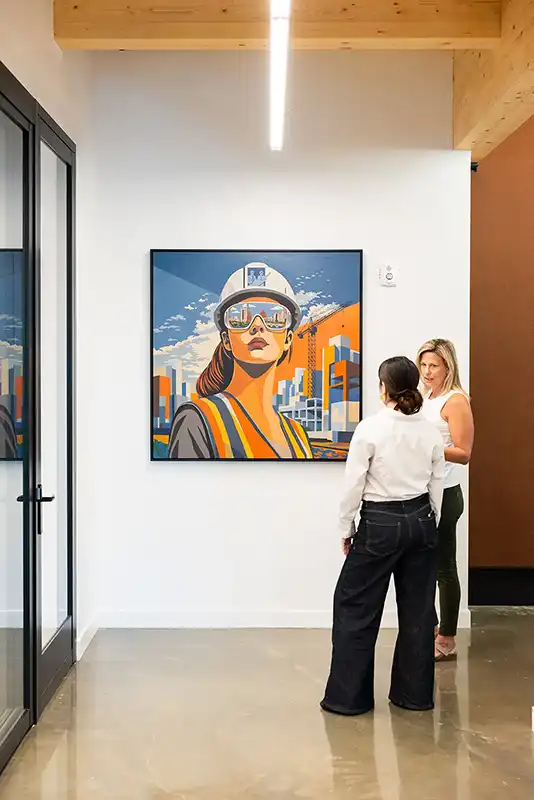
A commissioned portrait of a woman in a hard hat sits at the entrance of Swinerton’s new Austin offices.
Jennifer Brener Seay (JBS): Alison, tell me a little bit about your background and how you ended up in construction.
Alison Satt (AS): I graduated with a civil engineering degree and went to work for a general contractor in San Francisco. There’s actually a pretty even ratio of men and women in San Francisco working in entry level construction—about 50/50. As you advance, the number of women starts dwindling.
AS: I graduated in 2006 when there were still people in the industry who treated me differently because I was a woman, but I decided to stick with it. I was an assistant superintendent, climbing around job sites and laying things out and working with the foremen and asking all the questions.
AS: And it turned out I was really good at it because people just really want to be seen. They want to explain to someone what they’re doing. They want to be engaged and understood.
JBS: I love that you were in the field because that gives you so much practical experience and knowledge and understanding of what’s going on.
AS:Yes, people believe me when I make suggestions because I can say, well, I’ve been there. I’ve been in your shoes.
Satt’s ability to make others feel seen and included is part of what makes her a successful leader. It’s a skill that’s helped her rise steadily in the construction industry.
After spending her early career on job sites, Satt found her way to project management. In 2016, she went to work for Swinerton in San Francisco, eventually becoming a project executive. In 2022, Swinerton asked her to head up their Austin location.
Since then, Satt’s grown the Austin team from 35 to “somewhere between 110 and 120 people.” The Austin office’s annual revenue this year will be 320 million, up from 40-50 million in 2022. Satt credits the decision to diversify beyond tenant improvements to ground-up construction across both public and private sectors. Today, their portfolio spans commercial projects, aviation, affordable housing, and K-12 education.
Last May, Alison and her team finished construction on WORKBENCH and moved into their new offices on the second floor.
The WORKBENCH Project: Walkability, Community and Possibilities
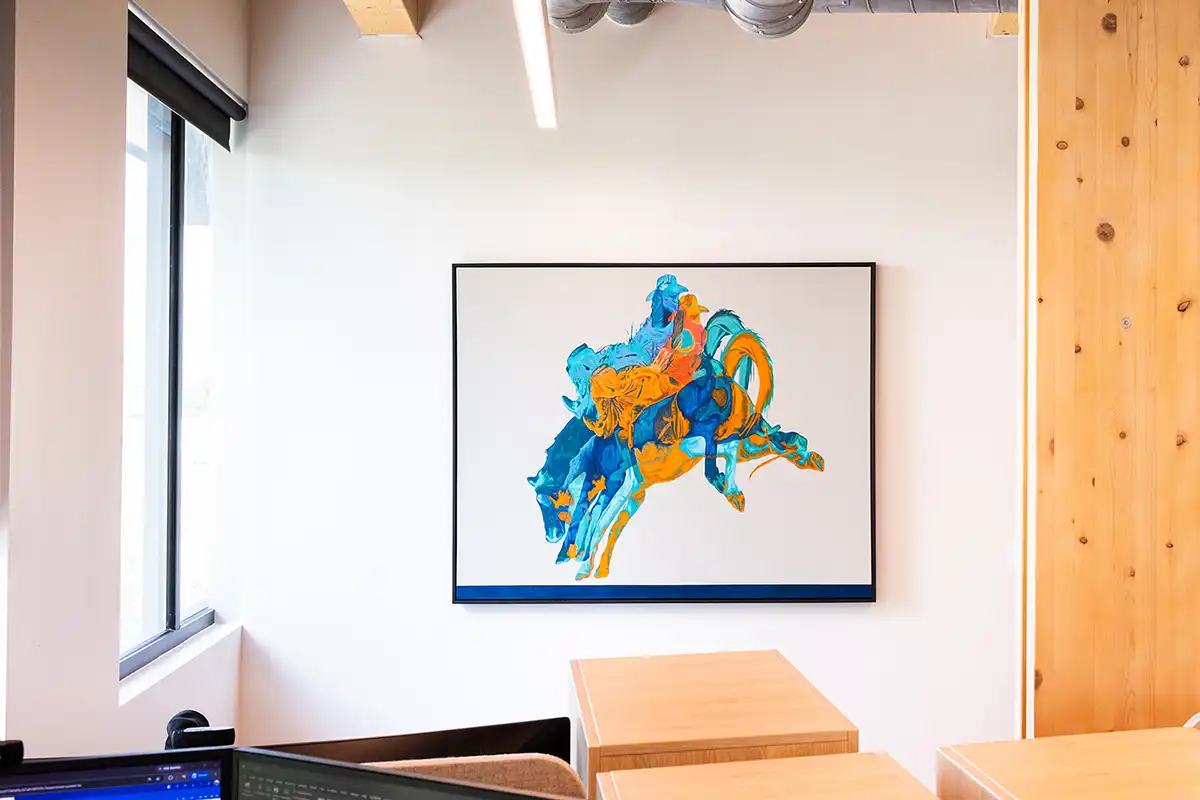
This acrylic on canvas piece is based on a favorite mural at Austin’s Moody Center and commissioned from the same artist.
JBS: What drew you to the WORKBENCH project?
AS: Mark (Vornberg, principal and architect at Dick Clark + Associates) approached us because we own a mass timber company.
JBS: You didn’t know each other prior to that?
AS: No. So, I met him, and I instantly loved Mark. And, when he showed me his ideas and the land, I thought, “This is amazing.” Because one thing I really missed about working in San Francisco is that you can walk everywhere from our office there.
AS: You know, walk to coffee shops, walk to lunch. And I think that’s really important when you have clients and subcontractors. Being able to meet them and go eat or have coffee or whatever. And your employees also want to feel part of the community and get to know all the local areas. So that was a huge perk for me here.
AS: I also really like the idea of owning a place and being able to say we’re here permanently. Part of my whole vision for our team is to be community builders. So, you know, we build schools only where we have people who live in the school districts because we want to be able to say that we’re committed to these projects because our kids go to school there. Affordable housing and public civic infrastructure are also really important to me.
AS: Another reason I wanted to get involved is that WORKBENCH is just such a showcase of possibilities. We did a different mechanical system on every floor and left everything exposed on our floor so that we could teach our people and we could show owners what their building systems could look like. It could look like this, or we can go up to the 3rd floor and show them a raised access floor. And then we have board-formed concrete in the basement. It’s so wonderful to be able to show people what it can look like.
Another reason I wanted to get involved is that WORKBENCH is just such a showcase of possibilities.
JBS: It’s so smart because it’s really hard to understand those differences and it’s just so much easier and effective to show them.
Innovation through Mass Timber
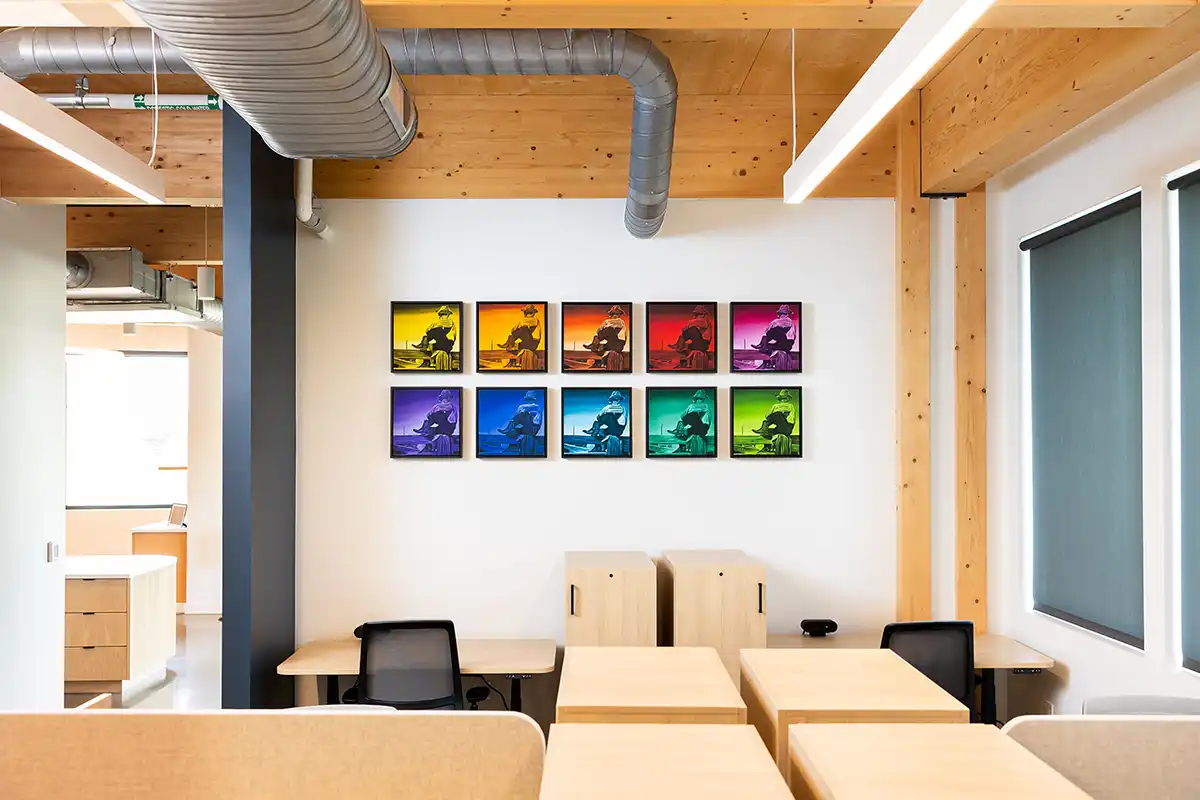
A multi-colored print on canvas of a cowboy on a wooden fence invokes the Texas spirit.
JBS: Tell me about the mass timber aspect of Swinerton’s business.
AS: One of the cool things about Swinerton is that we have 23 offices, and everyone in my position is encouraged to be entrepreneurial and flexible and thoughtful about the businesses that we run. We’ve been in business since 1888 and the way that we’ve done that is to encourage our employees to bring ideas to the forefront. If they have a great idea, they have the potential to become their own business.
AS: Most recently, there was a project manager who was really interested in mass timber. So, he ran a few mass timber projects and then he was like, “Hey, executives, I think it would be great if we started our own company because this is a more sustainable way of building. It’s also a beautiful building, and it’s a differentiator.” We created our own company called Timberlab, and that project manager is now the president. His name is Chris Evans.
AS: We started out purchasing and installing the material. And as we have evolved, we now are a fully vertically integrated company. We own the sawmills, the CLT manufacturing, the glulam manufacturing. We have engineers who work for us who design the connections. They design the structure. And so, we are now the largest builder of mass timber in the country. And we’re able to offer our clients a different product which, you know now that you’ve been in a mass timber office, it feels better.
JBS: It does. In fact, we were giving a tour yesterday to some architects and interior designers and they just kept commenting on how warm and welcoming it felt. That timber just gives a whole different feeling that you can sense when you’re in the space.
AS: Yes. The early adopters are education facilities, so higher ed, and they see the difference. Then municipal buildings, and now we’re starting to see interest from multifamily and offices, but yeah, it really is. It feels different and also is better for the environment, so there are multiple reasons why it’s a good choice.
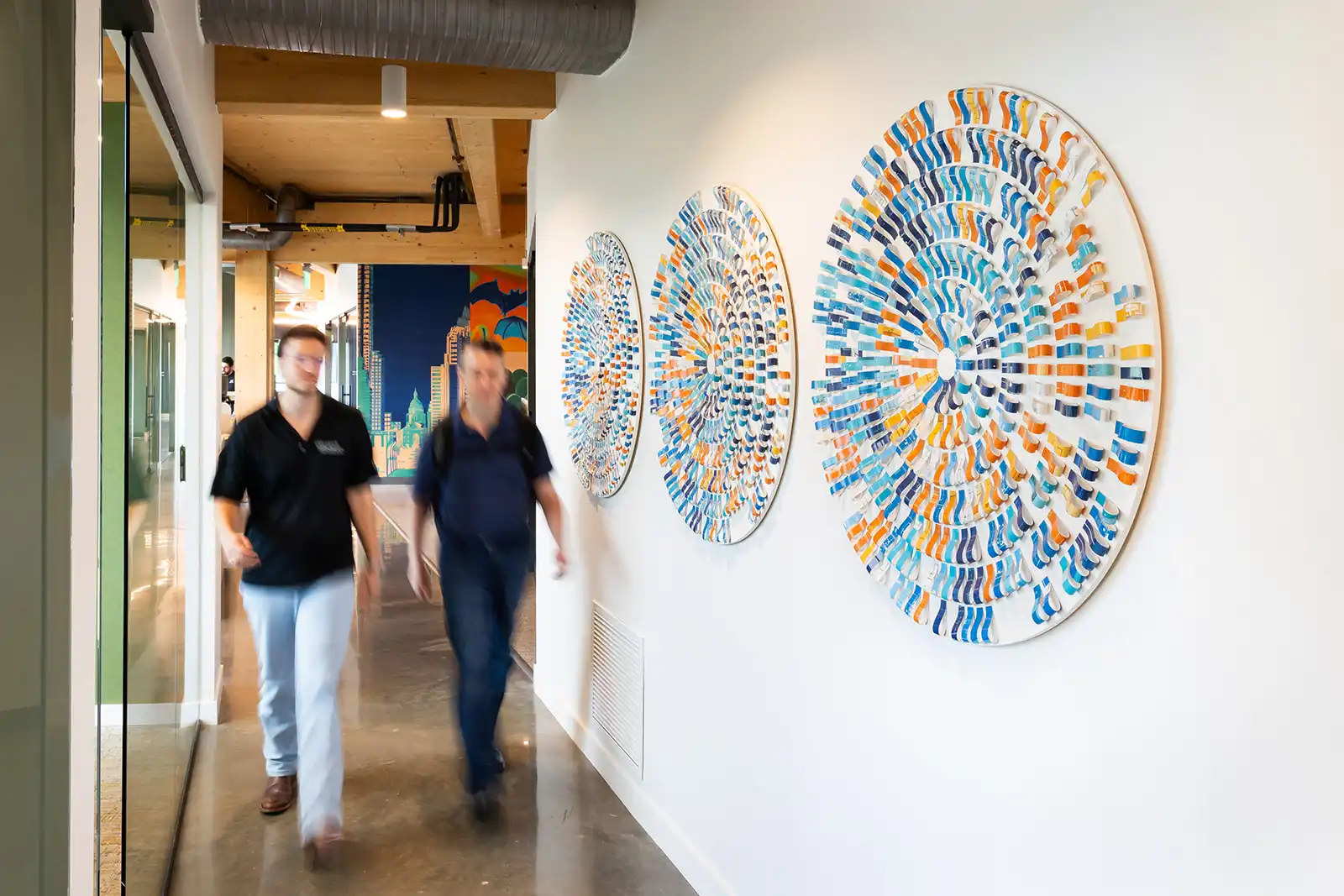
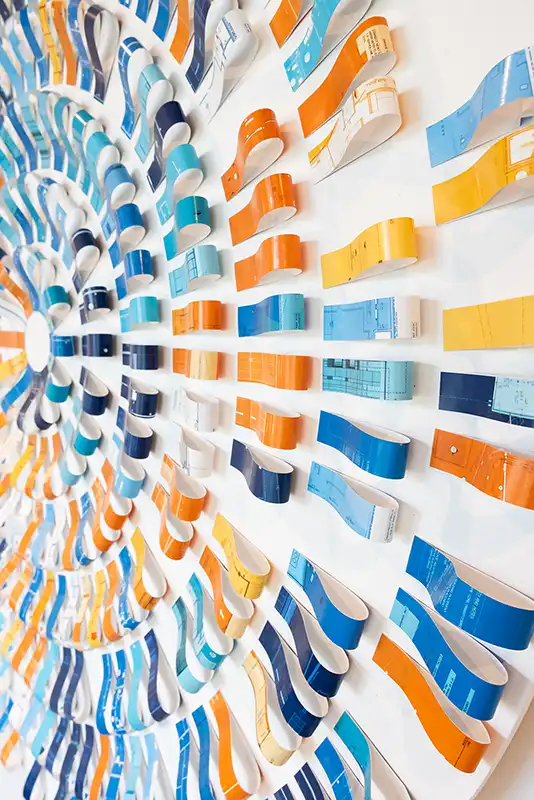
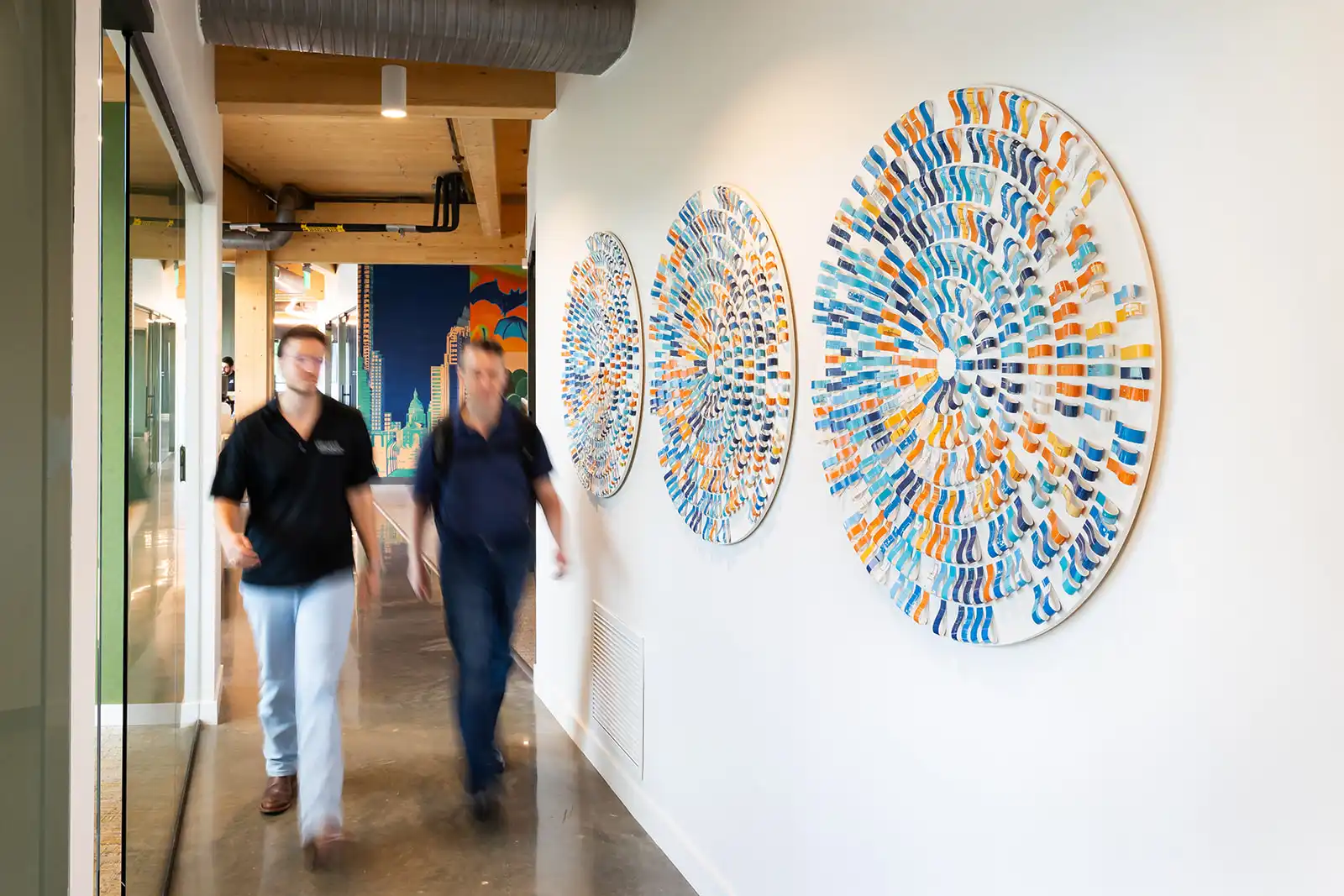
Blueprints of the office were dyed in Swinerton brand colors and arranged in 42″ diameter circles.
A Culture of Employee Ownership
JBS: It’s so interesting what you were just saying about Swinerton being over a 100 years old, but such an innovative company. Tell us a little bit more about the company culture.
AS: I think there are a few things about Swinerton that encourage us to be innovative. I think that the first thing is that we’re employee owned. So, from day one, you are an owner, but no one can own more than 4% of the company. Which means that no one is more important than anyone else and that shows up in the decisions that people make every day, they are thoughtful about why they do everything. And that 4% shareholder could be a superintendent who has been here for 40 years and started as a laborer and their stock started at $8 and now their stock is $90.
JBS: That’s such a cool system.
AS: It’s allowed me to build the team I need in this market and chase the projects I think are important for the community. I think that level of ownership from the leadership level down allows all of our employees to feel the same way. I empower all of our employees, if someone has an idea, bring it to me, you know?
AS: A project engineer came to me the other day and let me know they heard that project engineer salaries were not all the same. And they asked if I could explain why. I looked into it and realized, oh my gosh, there’s a mistake. I thanked them for bringing it to me and let them know I would make an adjustment across the board to every man. I said, “I know this probably took a lot for you to come to the division manager and say something but thank you because you just made a difference in 30 people’s lives.”
JBS: Wow.
AS: Those project engineers are now going to feel like, “This company is looking out for me. And I want to do my best for them because they’re doing their best for me.”
JBS: I also think it speaks to your leadership and a level of safety that employees feel with you, that they can come to you with something like that.
AS: Yeah, it goes a long way.
Why A Veteran Builder Invests in Workplace Art
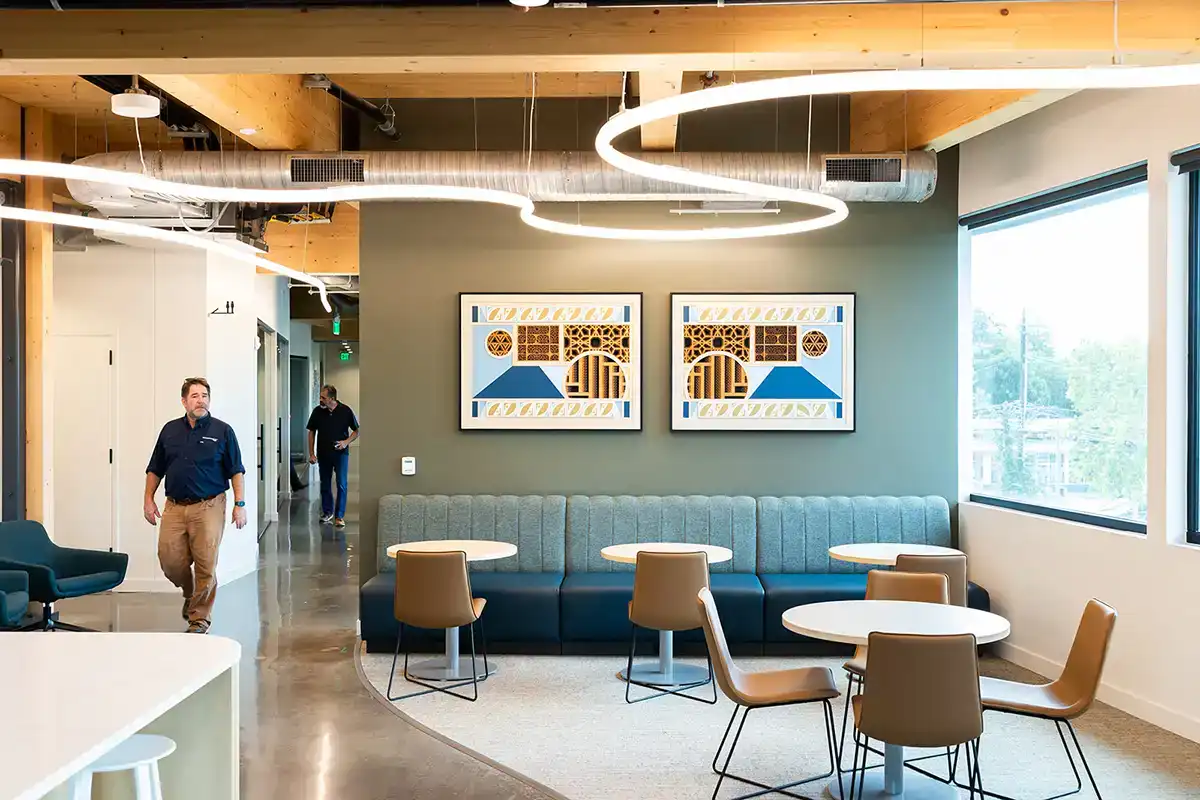
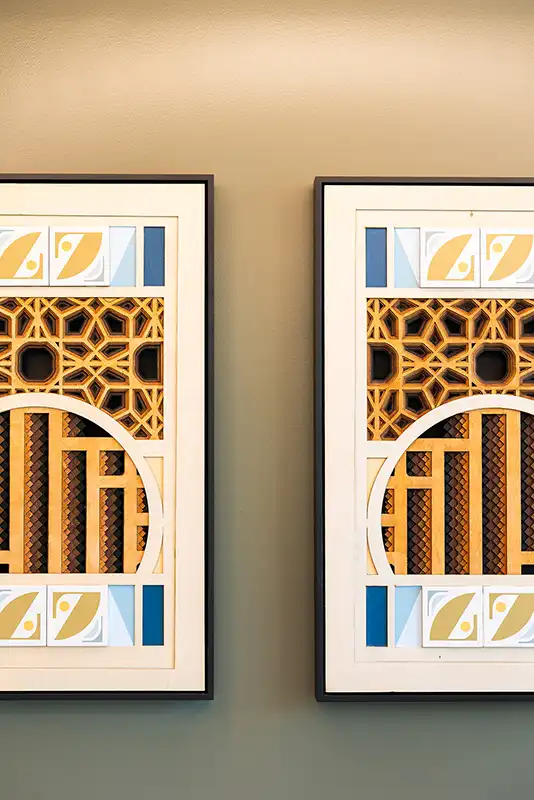
Mixed media, wood cutouts hang in the employee break area.
JBS: So, when you were moving into WORKBENCH and planning for the building, how did your leadership style and your experience play into your decision to invest in art?
AS: I have built so many buildings and because I’ve had the opportunity to see what so many different people decide to do with that final product, I’ve seen the difference that art makes in a space. And to me, it’s the difference between a welcoming environment and one that isn’t.
AS: When I see a space that has beautifully curated art, I feel energized. I feel like it’s a warmer and more homelike environment. And I feel like it provides inspiration for interaction between people. So, to me, that was one of the most important parts—the space is not finished until you have the art.
To me, that was one of the most important parts—the space is not finished until you have the art.
AS: It was absolutely wonderful knowing that there was someone who could guide us and show us exactly what would fit here and why and the meaning behind all of the different pieces. I think every single day, I look at one or more of the pieces, and it spurs some thought. Every single time I walk a person through our space, they have a question about one or more of the pieces of art.
Using Art to Represent Company Culture
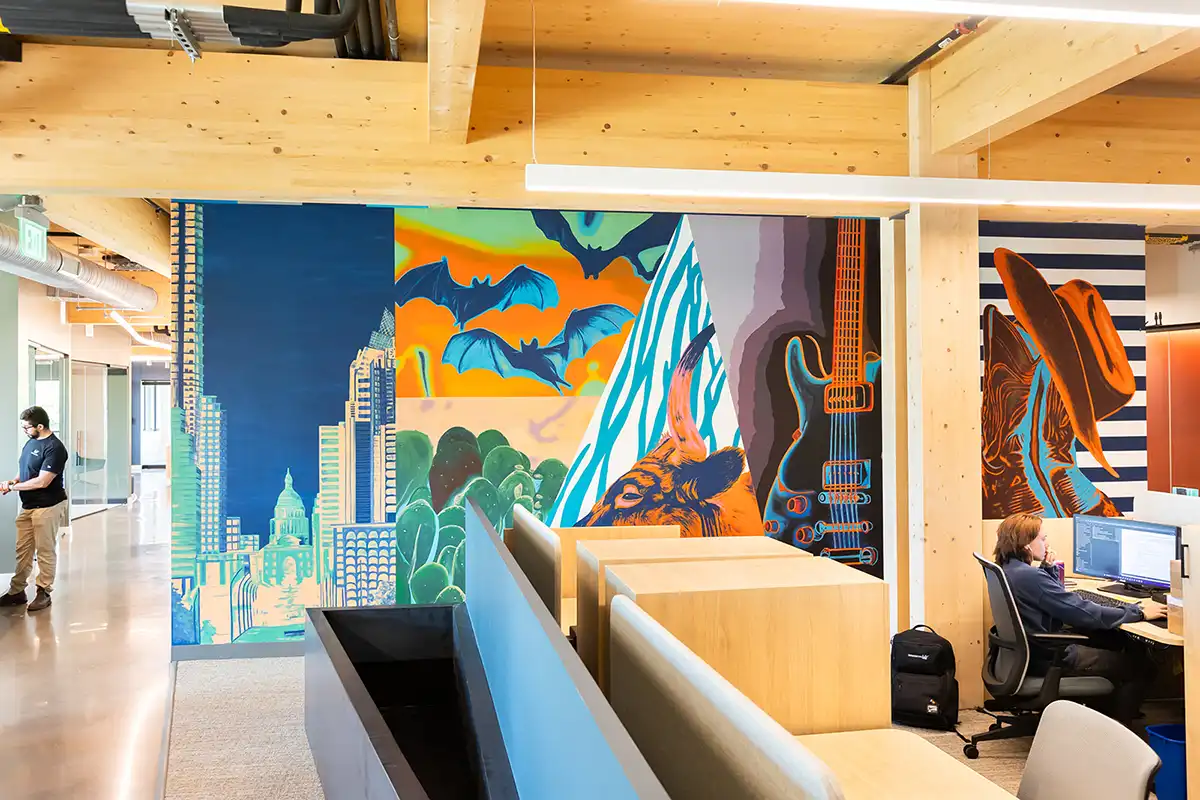
A large-scale mural invokes a strong sense of local Austin culture with elements like the Austin skyline, bats, a longhorn, guitar, a cowboy hat and boots.
JBS: What were some things you wanted in the artwork to represent Swinerton and the experience people were going to have in the space?
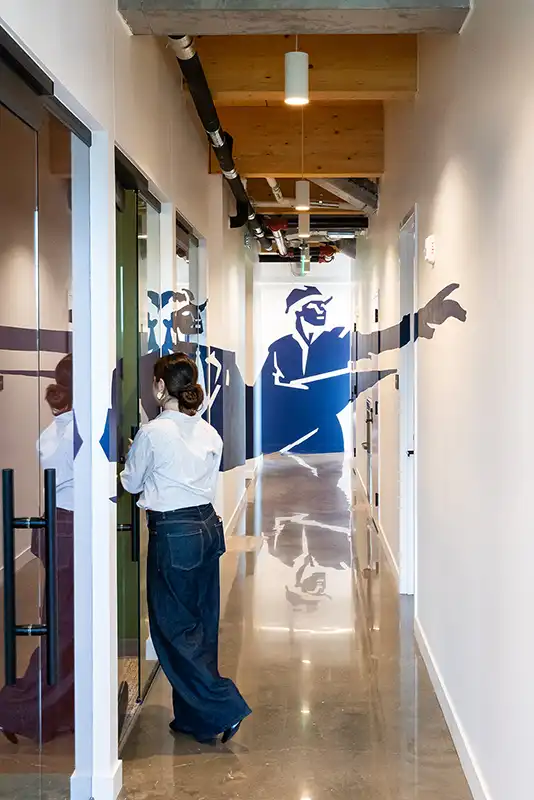
A hand-painted, anamorphic mural suddenly reveals the Swinerton logo in 3D when viewed from the right perspective
AS: We wanted to make sure we had the Austin vibe going on to communicate that we are local and this is our Austin team. That was super important. We also wanted to communicate this is a construction office, so the pieces with the blueprints of the plans and our colors is just like, oh my gosh, they’re so perfect.
JBS: I love those pieces so much.
AS: And then we wanted to incorporate Swinterton, so we have the Swinterton logo, which is, again, we’re from 1888. So, we’ve got to incorporate the logo.
JBS: I absolutely love the 3D mural with your logo and just watching people react to that piece as we tour them. It’s so cool.
AS: You know what else I really love are the multidimensional wood cutouts over in the kitchen. Every time, I notice something different about them and I just love those.
JBS:We were walking through with the architects yesterday and they were commenting how the pieces are mirrored and so detailed and how cool it is for them to be mirrored like that and how complicated that is. I hadn’t thought of it like that. It’s always interesting to hear different perspectives.
Giving Employees a Sense of Belonging through Art
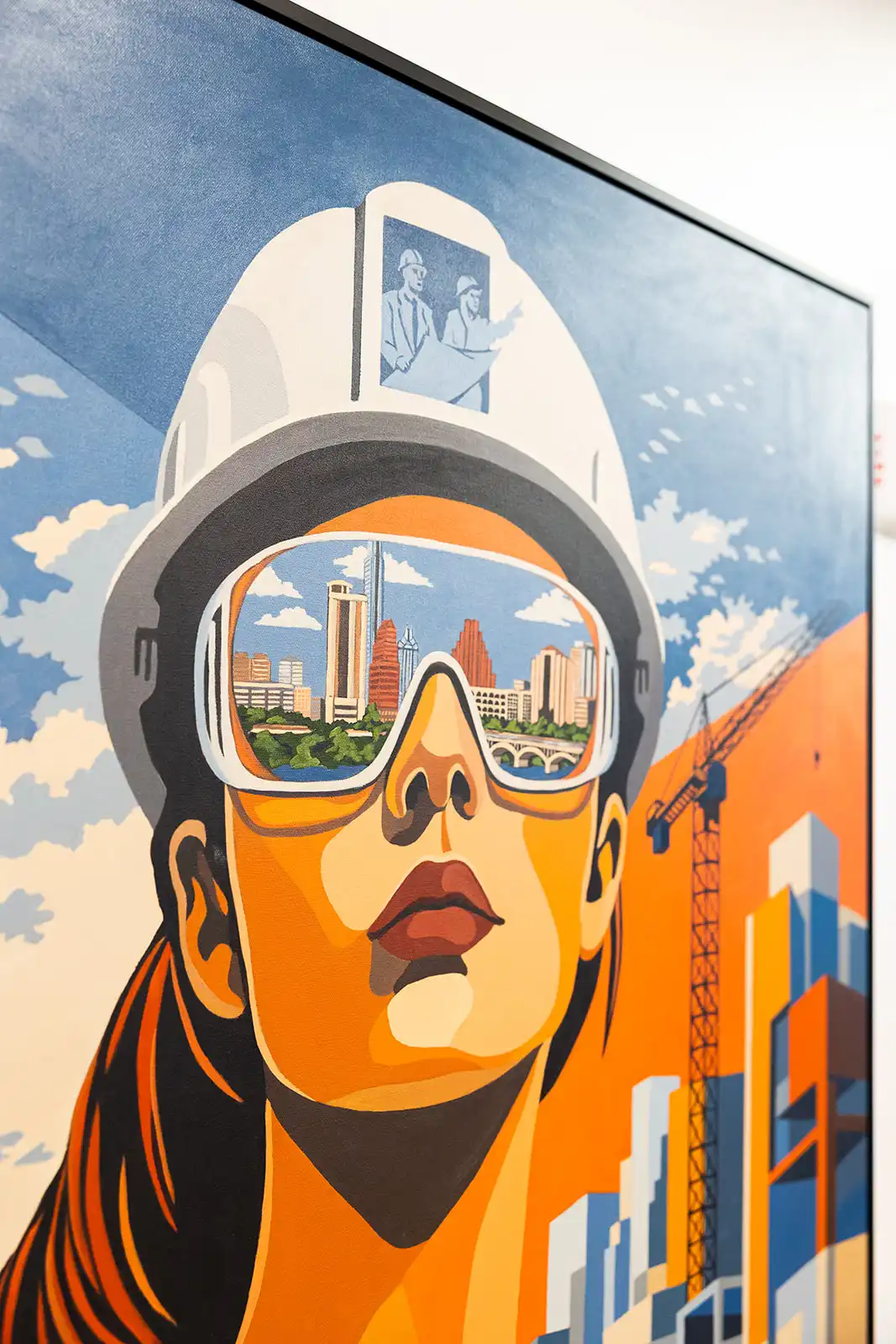
AS: And then my absolute favorite piece is the woman in the hardhat because I’m all about inclusivity. I’ve never seen a picture of a woman in a hardhat in a construction office. I want everyone who walks through our doors to feel like they belong here, so that piece was very important to me, and I cannot tell you how many people have looked at that piece and they’ve been like, “Why do we not have this everywhere? Why do I feel like this is so forward thinking? Because it shouldn’t be, but it is?”
JBS: I agree. How have you seen employees respond to the art?
AS: People love telling stories about the artwork to people who come visit. And you can just see when people are walking through, they’re looking at it themselves or they’re talking with each other about the pieces of art. I think that it just like pulls everything together and just makes people feel, you know, like, this is where they belong.
JBS:I always love that about art. Back to what you said earlier about listening to people and getting a good response to that, I think a big part of your leadership style is creating that safety and sense of belonging for people to come and talk with you.
AS: I think, in any industry, the best leader is not the person who knows everything, right? You can’t know everything. The best leader is someone who is going to listen to all of the ideas and bring all of the great ideas together in one room and get them to all work together. That is the kind of leader I am. I’m pretty self-aware and know the gaps that I have and I’ve filled those gaps through the people on my leadership team. And they’re all amazing.