

Humans are profoundly guided by emotion. Scientists estimate that 90% to 95% of our decisions and behaviors are shaped by emotion, often without our conscious awareness. That’s why experience is the ultimate measure of success for any commercial real estate project. It comes down to how people feel in your space.
Whether you need to lease up or retain talent, if you’re designing spaces with human experience in mind, you should know that art has the power to tap into emotion like little else. Especially when viewed in person. And now, scientists in the field of neuroaesthetics are proving it.
In this article, we’ll explain why art is an indispensable tool for creating spaces that engage people on an emotional level. As well as how scientists are amassing an ever-growing body of evidence to support that claim. We’ll also show you examples of original art from our past projects that cut through the noise to create memorable experiences people want to revisit.
Want to Connect with People? Connect with their Emotions
Emotions are core to human decision making. Scientists have come to understand that our brains process emotional stimuli much faster than rational thought. In common terms, we have a gut reaction that sets the stage for the choices we make. We aren’t rational beings with emotions. We are emotional beings who rationalize. When you engage people emotionally, you have the opportunity to inspire measurable action, build lasting loyalty, impress important information, and foster deep trust.
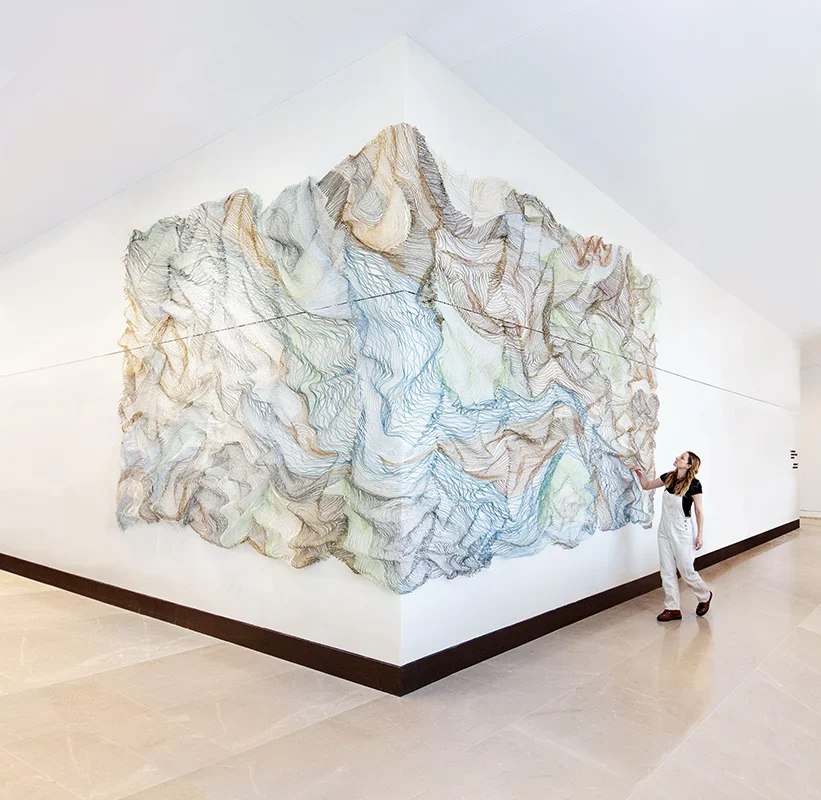
A woman examines a large-scale, woven leather wall sculpture at TIAA’s new corporate hub in Frisco, Texas. Art consulting by Art + Artisans.
Want to Connect with People’s Emotions? Use Art
So, how can you evoke positive emotional experiences in the spaces you design? With original art. That’s not just our opinion. Science backs it up.
In 2011, Professor Semir Zeki of University College of London found that viewing a beautiful piece of art triggers an immediate release of dopamine in the brain’s reward center. This is similar to what happens when you look at a picture of someone you love.
In 2012, Edward Vessel and his research team at NYU observed through MRI scans that viewing beautiful art activates the brain’s default mode network. This is the area responsible for daydreaming, self-reflection and self-identity. Up until that time, scientists believed that the default mode network turned off anytime you looked at something in the outside world. Vessel’s discovery revealed art’s unique power to engage with our most inner consciousness.
This discovery fundamentally changed the field of neuroaesthetics by proving that truly powerful art bridges the gap between external perception and our internal sense of identity.
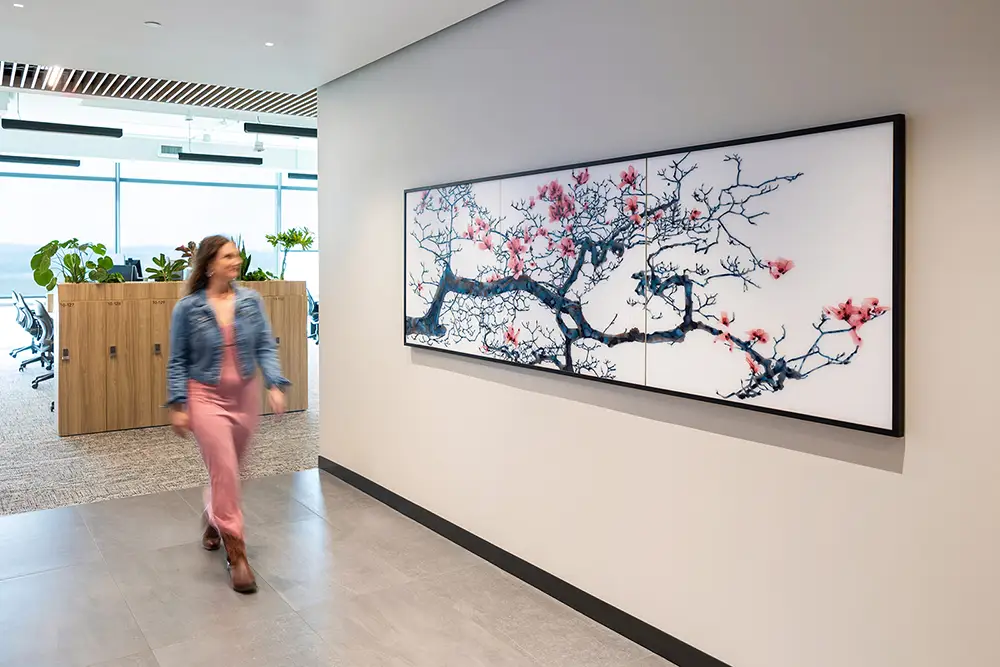
Researchers have found that our connection to art is enhanced when we can see it in person. Image: Tokyo Electron art program. Art consulting by Art + Artisans.
Seeing Art in Person is Even More Impactful
Our connection to artwork is enhanced when we’re able to see it in person. Being able to experience important aspects like scale and texture leads to deeper understanding of, and emotional resonance with, the art and even the artist.
A recent experiment in The Netherlands used an EEG to study the brain activity of people viewing original works of art in person vs. viewing a poster print of the same piece. The EEG recorded 10 times the approach motivation from participants viewing the real artwork in person. MRI scans later revealed incredible stimulation in the part of the brain that corresponds with the default mode network while viewing the same works of art.
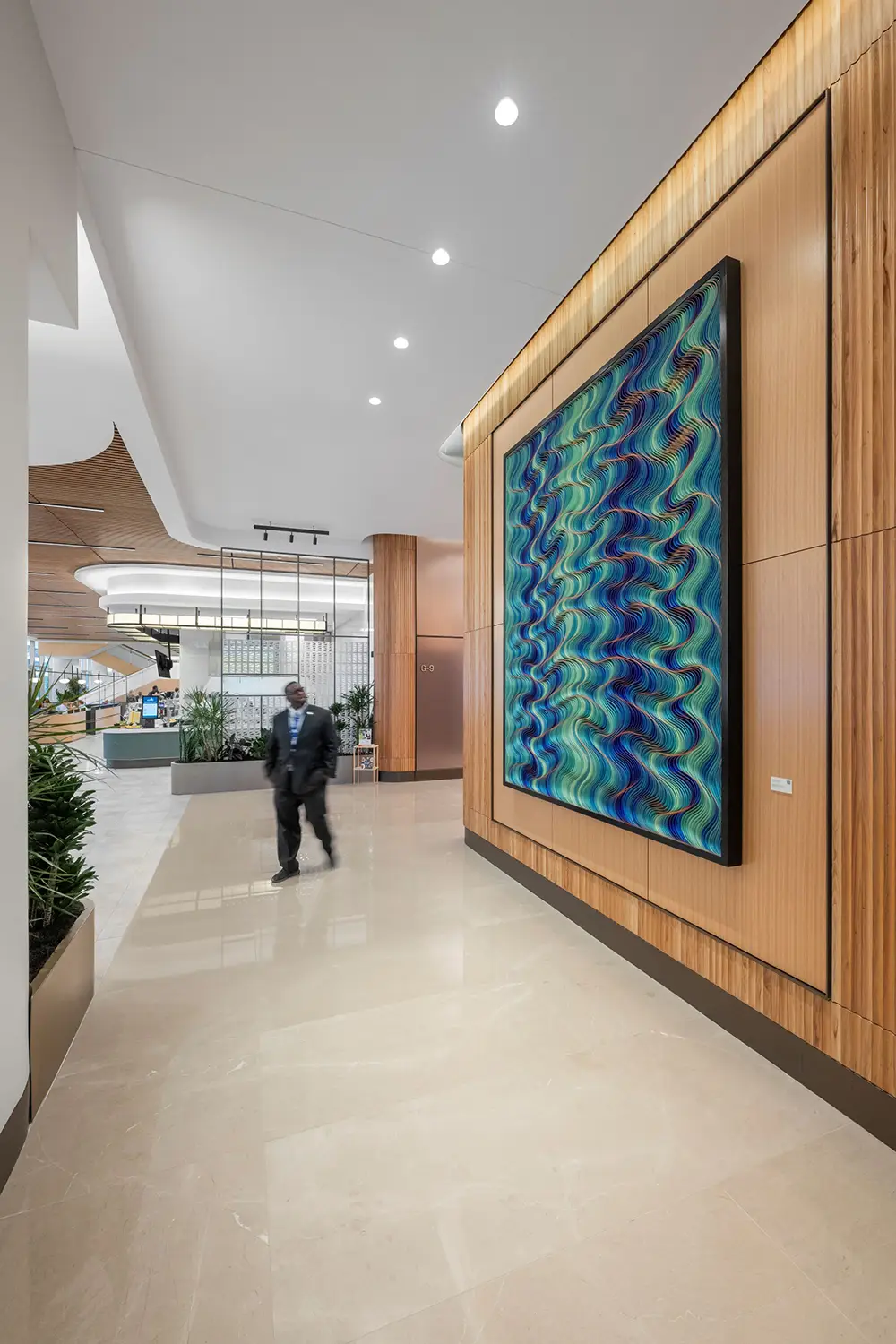
A recent study found that looking at original art in person has more health benefits than viewing a poster print. Image: Original art commissioned for TIAA’s corporate hub in Frisco, Texas. Art consulting by Art + Artisans.
Health Benefits of Viewing Art in Person
Science has demonstrated a link between emotional states and physical health. Negative emotions can lead to chronic stress and various health issues, while positive emotions are associated with better health and well-being. This might be why a recent study by King’s College in London found that viewing art has a positive impact on the immune, endocrine and autonomic nervous systems, reducing stress hormones while simultaneously increasing excitement. Most compellingly, in-person viewing of art appears to have far greater benefits than viewing reproductions. Here are some of the exciting findings from the study:
- Levels of cortisone, a stress hormone, fell by an average of 22% for in-person viewers of art compared to 8% for the group looking at reproductions.
- Two proteins involved with chronic inflammation dropped by 30% and 28% respectively for in-person viewers of original art, with no change observed in the group viewing reproductions of the artwork.
- Heart rate monitoring revealed that viewing original artworks in person elicited richer, more dynamically variable heartbeat activity. The data implies an engaged, emotionally aroused, and adaptive physiological state rather than relaxation.
- Episodes of skin temperature cooling were also observed in the group viewing the artwork in person. Lowered skin temperature is a mild sympathetic nervous system response to aesthetic engagement.
“The research clearly shows the stress-reducing properties of viewing original art and its ability to simultaneously excite, engage and arouse us,” Tony Woods, one of the researchers at King’s College said.
Coordinating Original Art with Prints
Even if your plans are to obtain a majority print package, a few original pieces of art placed in key areas can create special moments that deliver on the benefits discussed in the research. Well curated prints can be utilized to support the overall story and vision. A qualified art consultant will work with you to curate the right art package to meet your organization’s needs.
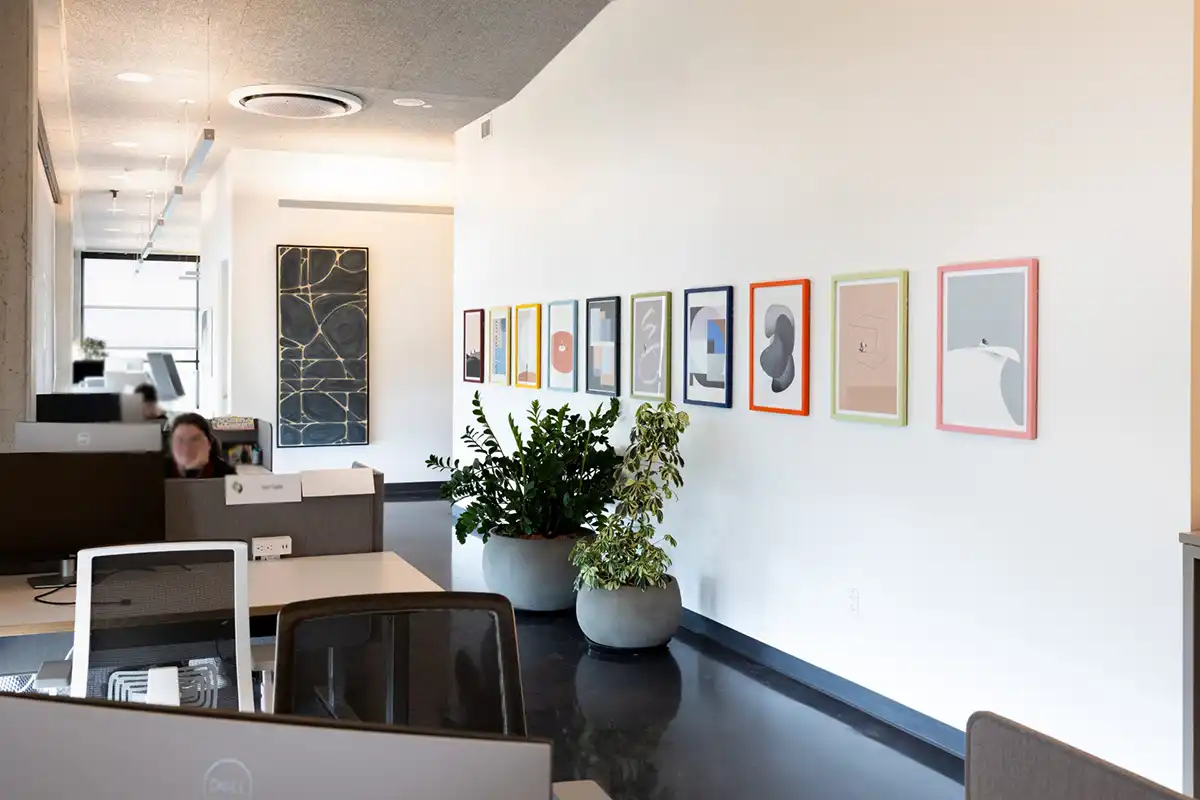
A row of framed abstract art prints lead the eye to an original abstract bas relief painting at Nutrabolt offices in Austin, Texas. Art consulting by Art + Artisans.
Original Art that Emotionally Engages
How does original art come together to transform a space? Take a look at some examples from our past projects.
Tangible, handcrafted art grounds a space, providing sensory richness and emotional resonance.
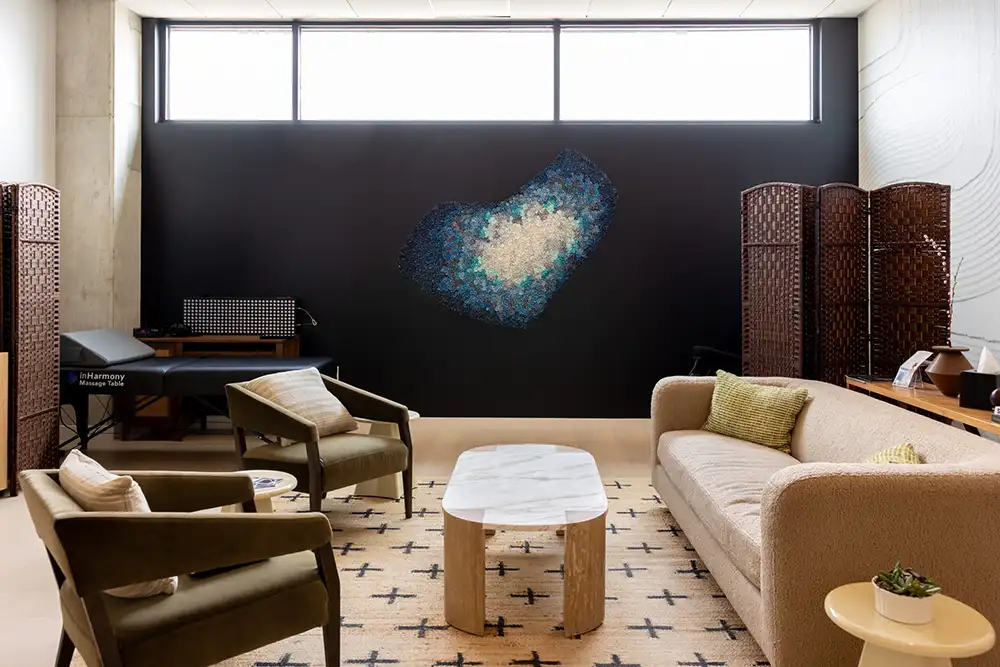
A hand-carved, textural artwork hangs in a lounge at Austin-based Nutrabolt headquarters. Art consulting by Art + Artisans.
Art acts as a luxury cue, playing a huge role in the emotional psychology of a property tour.
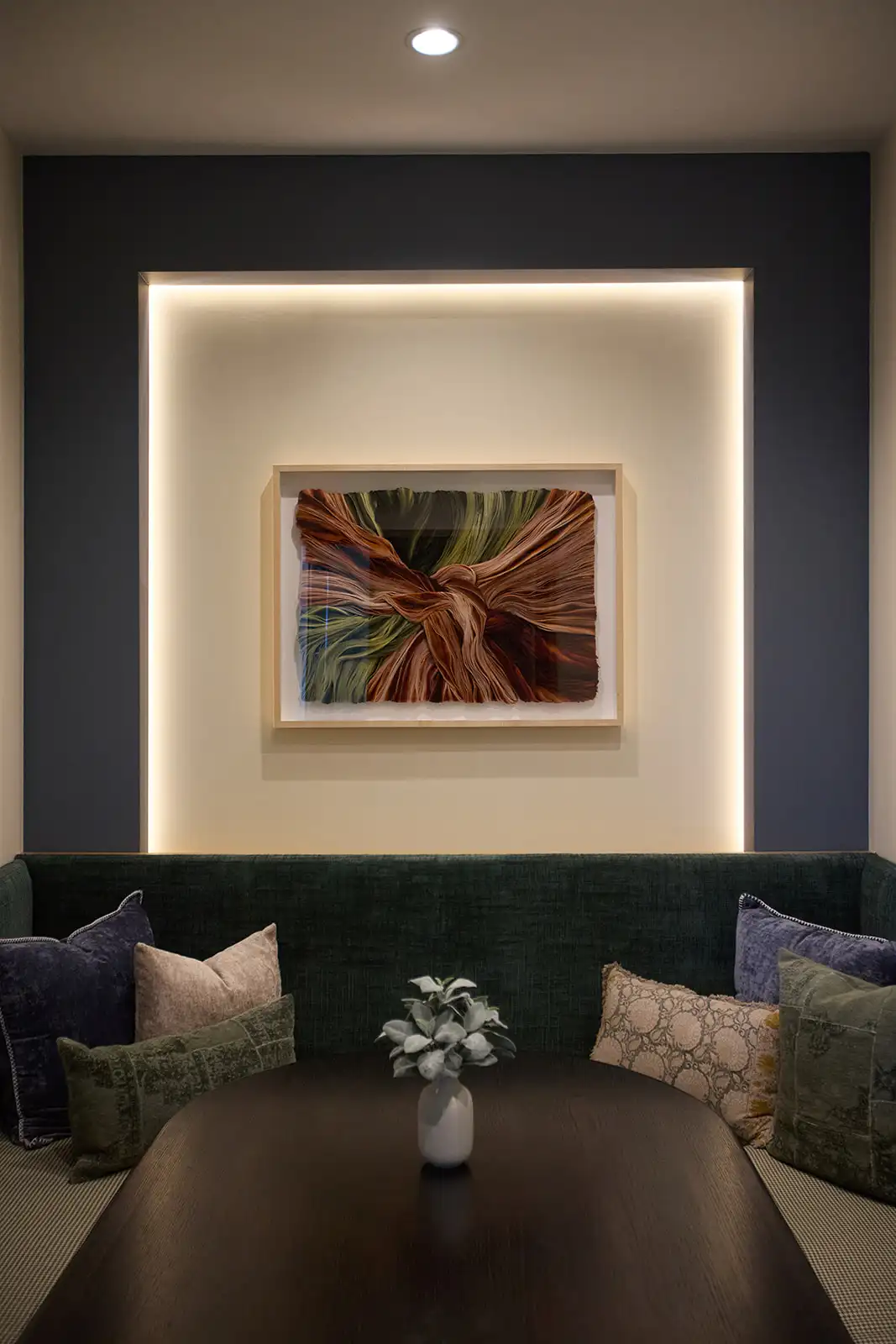
A dyed textile sculpture adds luxury to an amenity space at Modera McKinney Ridge apartments in North Texas. Art consulting by Art + Artisans.
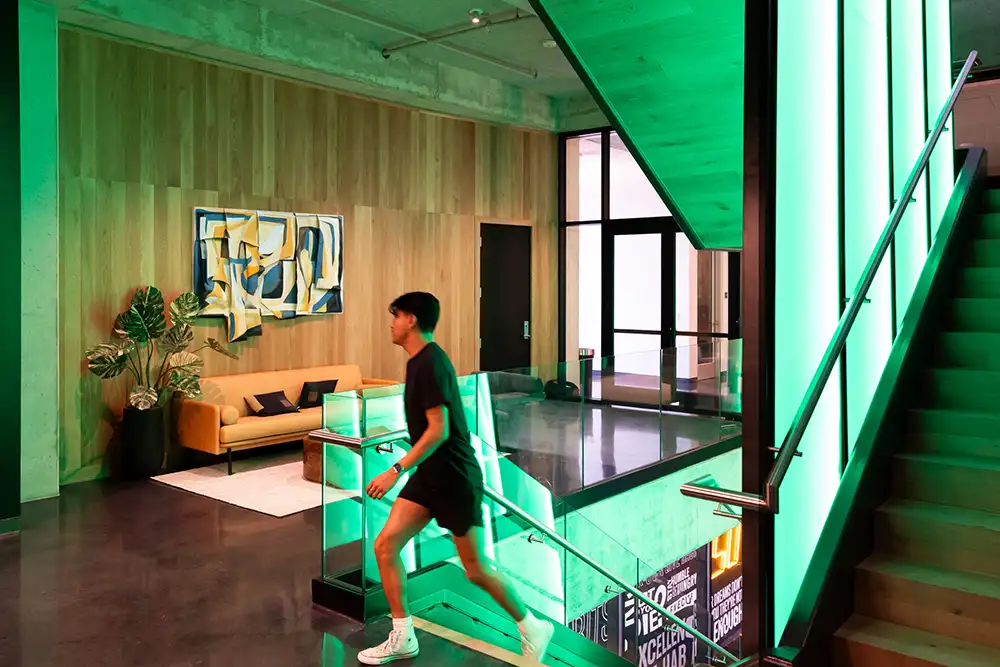
A dimensional acrylic, latex and varnish artwork on canvas hangs in a sitting area at Nutrabolt headquarters in Austin. Art consulting by Art + Artisans.
In workplaces, instead of creating a breakroom with just a coffeemaker and a TV, use art as the focal point of a dedicated quiet lounge. This becomes a place where employees can work on challenging problems.
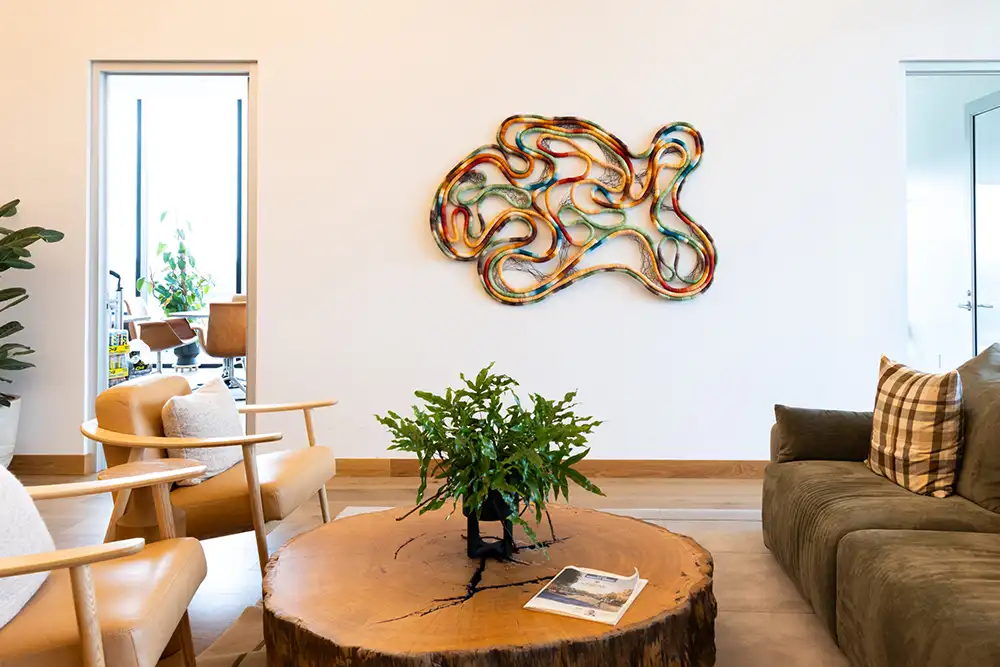
A chromatic soft sculpture hangs in a lounge area at Nutrabolt headquarters in Austin. Art Consulting by Art + Artisans.
By placing engaging art at natural transition points in the office, such as in hallways or near printers, you give employees mini mental breaks. This lowers stress levels, making the office feel less draining and directly impacting job satisfaction and talent retention.
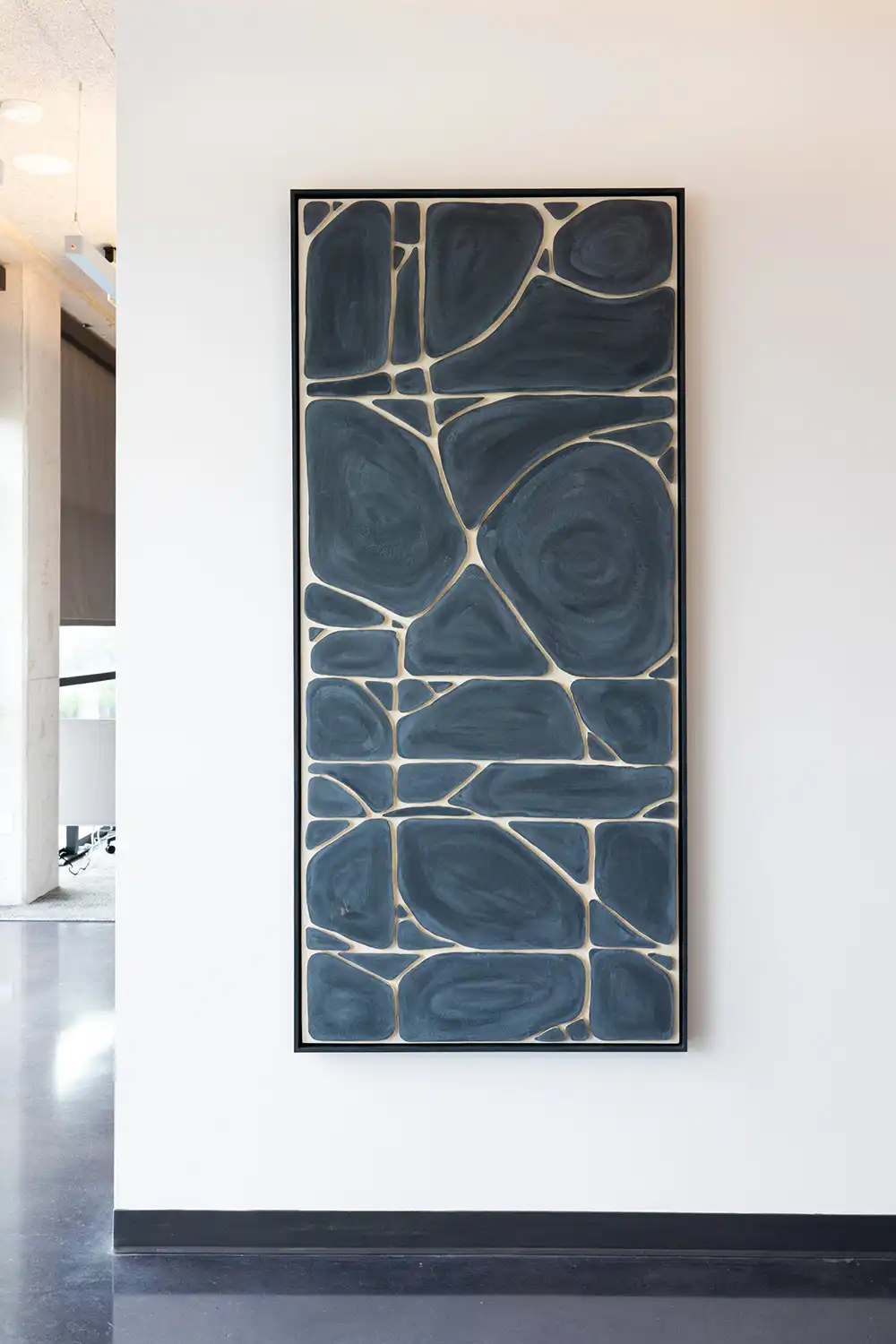
A lime paint on wood bas relief hangs in the Austin headquarters of Nutrabolt. Art consulting by Art + Austin.
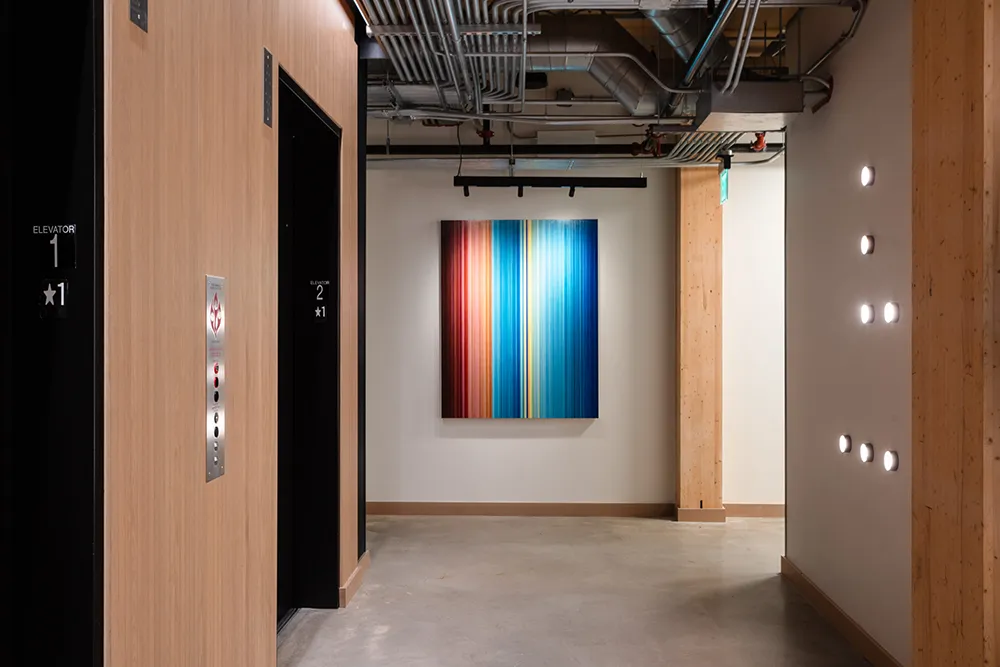
An acrylic reverse painting on acrylic provides a mesmerizing chromatic cascade in a corridor at T3 Eastside, a creative office space in Austin, Texas. Art consulting by Art + Artisans.
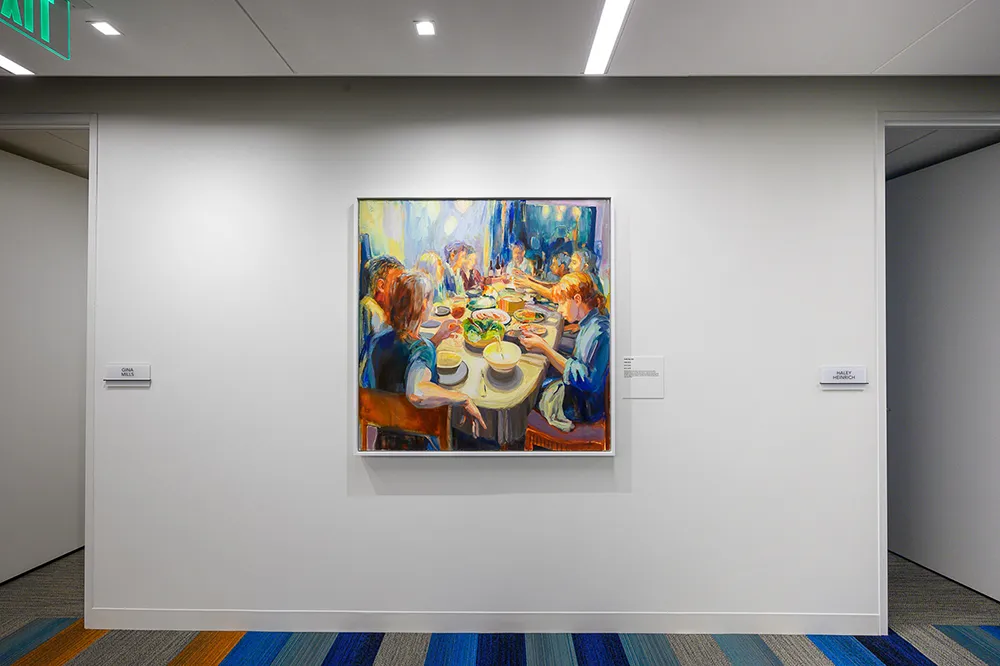
An oil painting of a big family meal adds warmth to a corporate setting at Thompson Coe law offices in Dallas, Texas. Art consulting by Art + Artisans.
At multifamily properties, use statement pieces to create an identity anchor in the reception area. When a prospective tenant walks into a lobby anchored by a high-quality, museum-grade art installation, their default mode network registers the space as meaningful, memorable, and prestigious. The property becomes a reflection of who they are.
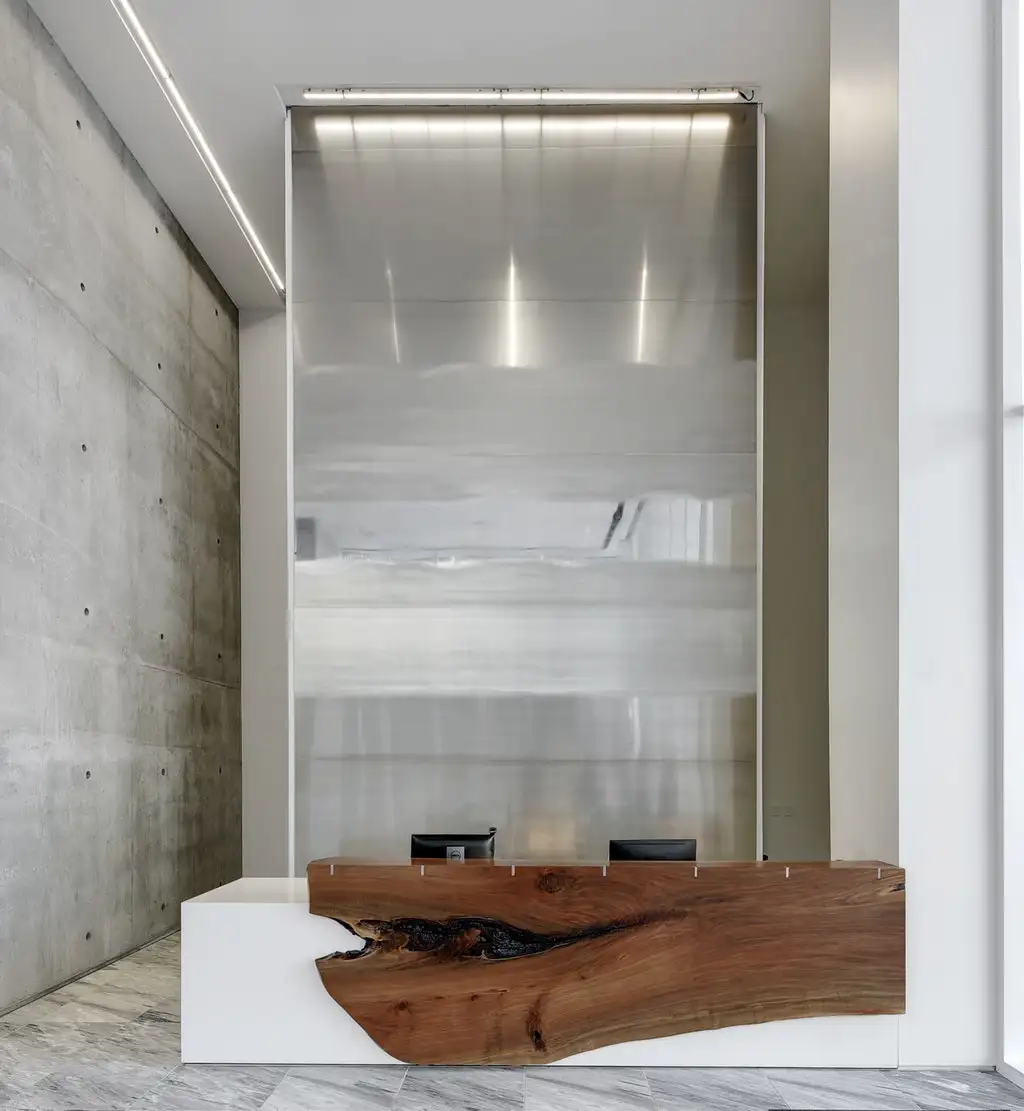
A brushed sheet metal installation behind the reception desk in the lobby of The Independent residential tower in Austin sets the tone for the modern elegance found throughout the building. Art consulting by Art + Artisans.
Don’t forget to use art to turn common amenity spaces into beautiful areas that make your community stand out and leave residents feeling pampered.
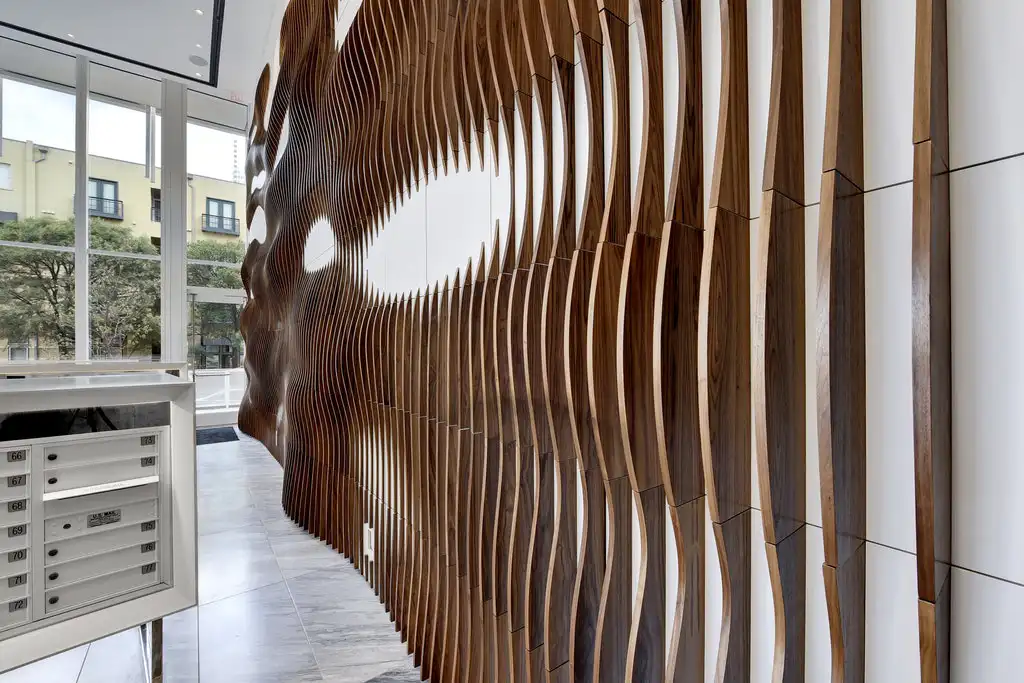
A dynamic, undulating wall installation of walnut and composite wood tiles lends warmth to the metal and concrete surfaces in the mail area in the lobby of The Independent luxury residential tower in Austin, Texas. Art consulting by Art + Artisans.
Invest in real, textured, local art with thoughtful gallery-style lighting in common areas to make a property feel genuinely local. It turns previously overlooked spaces into areas where people naturally want to linger.
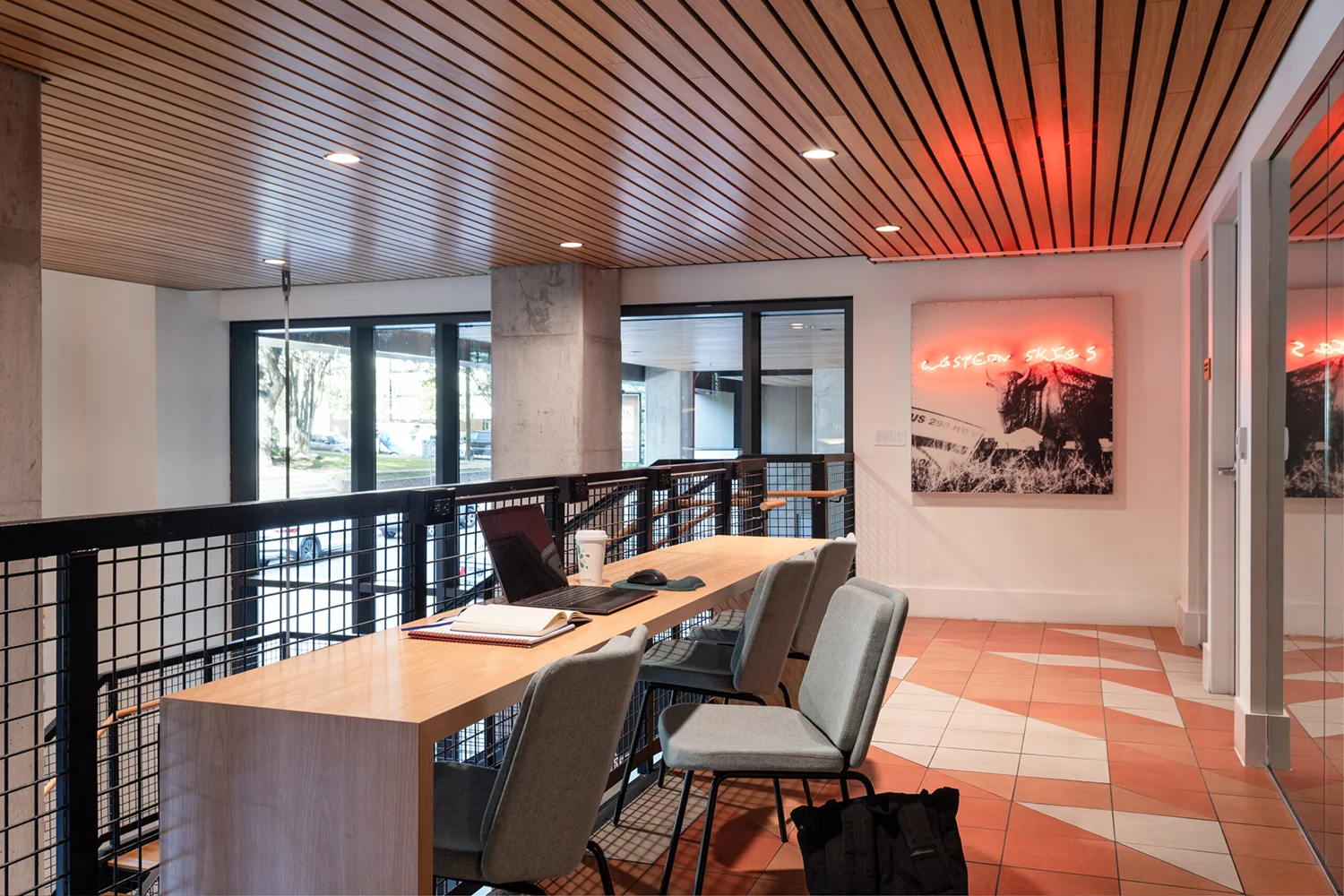
Neon art in a co-working space at luxury Austin student housing Union on San Antonio emphasizes the unique creative energy of the city. Art consulting by Art + Artisans.
Conclusion
When designing a space for human experience, understanding the emotional power of art is key. Original art thoughtfully curated transforms the experience into a deeply personal one and ensures that people want to return again and again. Now science is proving the superior benefits of having original art to view in your space.
Learn More about the Emotional Power of Looking at Art
- Toward a brain-based theory of beauty [Tomohiro Ishizu, Semir Zeki – PloS one, July 6, 2011]
- The brain on art: intense aesthetic experience activates the default mode network [Edward Vessel, G. Gabrielle Starr, and Nava Rubin, Frontiers, April 19, 2012]
- Feelings First: How Emotion Shapes Our Communication, Decisions, and Experiences [gsb.stanford.edu, November 20, 2026]
- Consumer Psychology: Why 95% of Buying Decisions Are Emotional [Research and Metric]
- The ‘pearly triangle’: neurological investigation reveals secret of Vermeer’s Girl with a Pearl Earring [The Art Newspaper, October 3, 2024]
- Neuro-research on Girl with a Pearl Earring [Neurensics, February 3, 2025]
- The Physiological Impact of Viewing Original Artworks vs. Reprints: A Comparative Study [pdf – King’s College London Research Portal, 2025]
- Art Fund research proves that viewing art is good for the human body [Museum Association, October 28, 2025]