
Architects know the transformative power of art for placemaking and shaping experiences. Across commercial real estate, architects use art to help solve one of their most complex design challenges. Namely, how do we get people to love this space?
In this article, we’ll show you how to select art based on a space’s intended use and “vibe” to create an impactful experience for the people in it. We’ll also go over best practices for planning and executing experiential art on your property.
The Power of Site-Specific Art
To get the best impact from art at your property, it helps to begin with the site plan. When we start a new project, the first thing we do is examine this important document. Often the architect has marked areas where they think art should be placed. We envision how each of those areas will be used and how the architect might intend for people to feel in each space. Then we come up with criteria for art that best bridges the gap between architecture and human experience. With this approach, we help clients select art that complements and enhances each setting.
Let’s look at a project that illustrates how this is accomplished in the real world.
Defining Experiential Spaces
A recent project for financial services organization TIAA provides the perfect case study for defining different experiential spaces within a property. You can read about the interiors at TIAA here. For the purposes of this article, we’ll focus on the exterior grounds.
When TIAA consolidated three offices into a new 15-story tower in Frisco, Texas, they understood the importance of making it a workplace worthy of the commute.
On the site plan, four different spots on the exterior were marked for art. Each space had a different function and therefore a different “vibe”.
To help define each space for the art selection committee, we took the opportunity to give them unofficial nicknames. This helped clarify the goal for each space, which in turn helped refined art selection criteria.
While each piece needed to enhance the desired experience, it also had to complement the design concept of Texas terrain established by the architect for the overall property.
1. Main Entrance
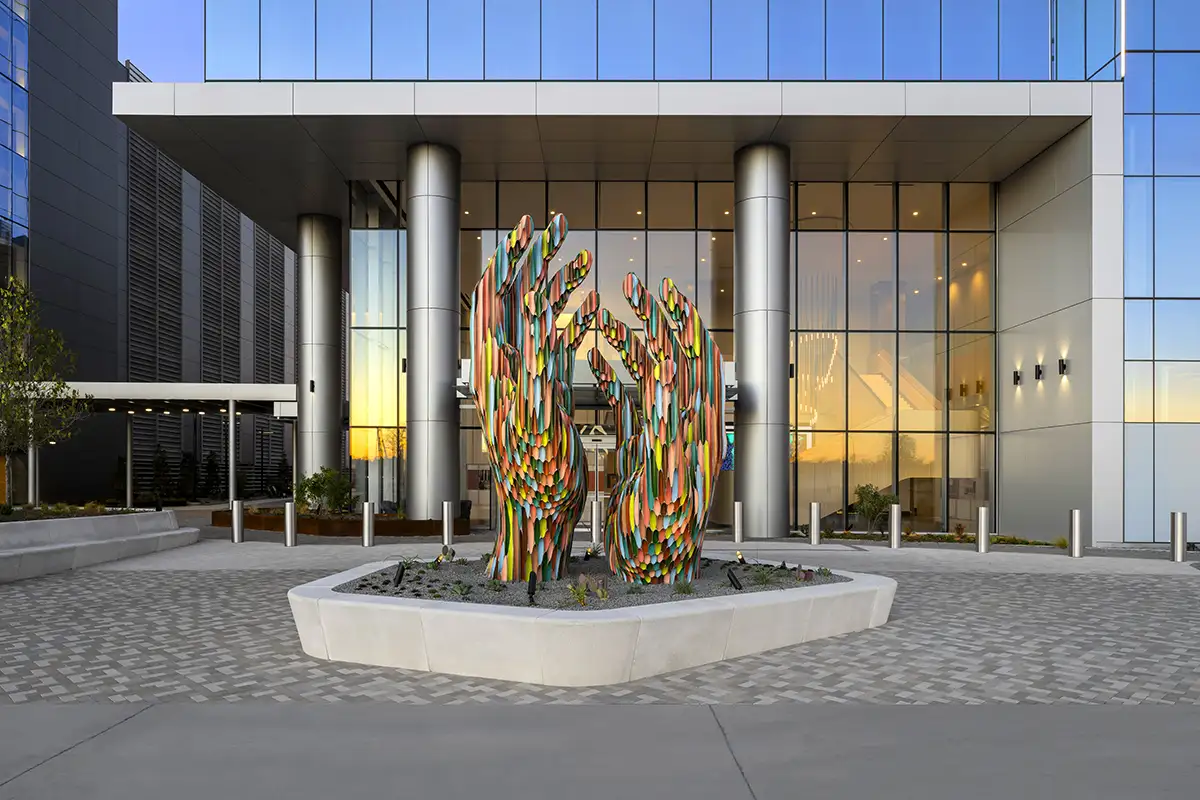
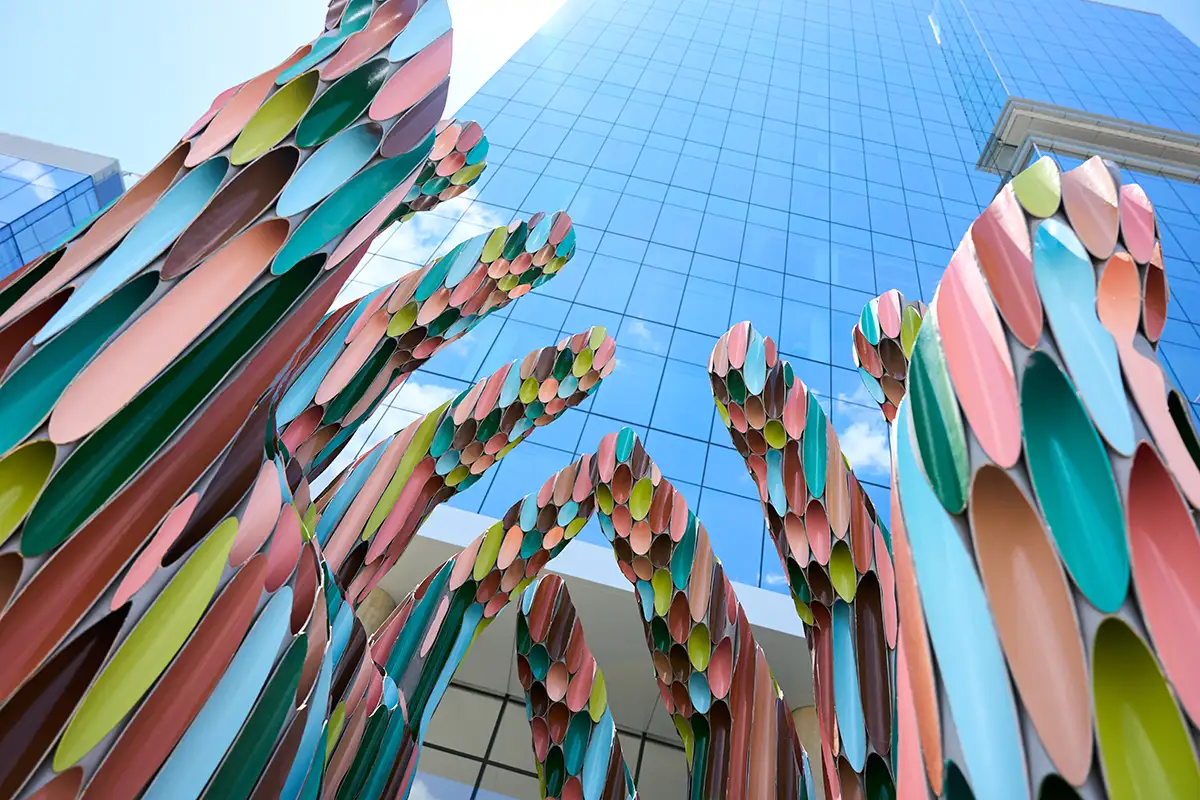
Unofficially nicknamed “First Impressions,” this area is the face of the property and can be seen from the highway. We saw this as an opportunity to begin telling TIAA’s story as soon as you arrive. TIAA was founded over 100 years ago with a mission to provide financial security for teachers. Educators still make up a large part of their core client base along with non-profit workers. In honor of that founding mission and their client base, a large-scale sculpture was commissioned consisting of two multi-colored hands outstretched towards the sky. The hands are constructed of steel pipes shaped to look like colored pencils. The hands represent service and the colored pencils education. The many colors represent TIAA’s commitment to diversity.
Gallery: A large-scale sculpture of multi-colored hands reaching toward the sky sits at the entrance to TIAA’s new Frisco, Texas office tower, visible from the freeway. The sculpture was chosen for the face of the building to begin telling TIAA’s story upon arrival. The hands represent service and they’re made of steel pipes shaped to look like colored pencils, representing TIAA’s founding mission to provide financial security for teachers.
2. Outdoor Event Area with Bar
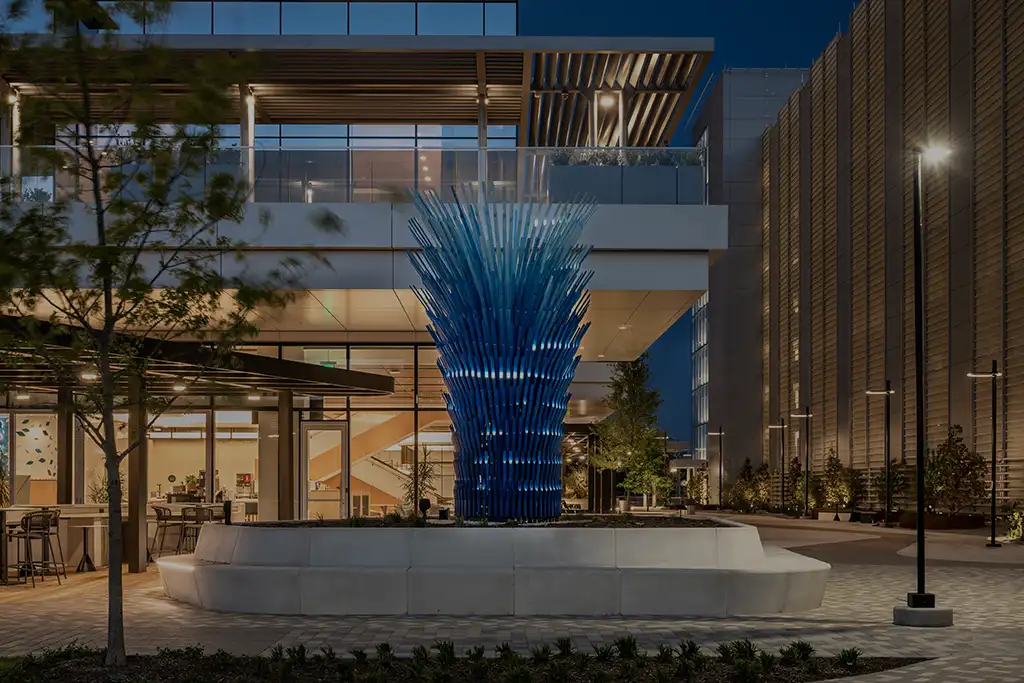
Unofficially nicknamed “Experimental,” this is a space for after-hours events where associates can have fun. To contribute to the atmosphere, we wanted more experimental artwork. “The thought was, I’m sitting at a bar, what do I want to look at?” asked Art + Artisans Creative Director Inda Hahn. “The key there was that it needed to be really amazing at night, not only daytime, because it would more than likely be experienced at night.” It also had to hold the viewer’s interest longer since people would be sitting in this area for extended periods. The result was a large-scale, computer-programmed light sculpture called “Bluebonnet.” By day, it’s a vibrant, two-story, modern representation of Texas’ state flower made up of 570 custom-colored, blue, steel tubes. (Blue is one of TIAA’s brand colors). At night, LEDs inside each of the tubes come alive with a series of custom-programmed effects that call to mind a field of bluebonnets swaying in the wind.
Video: A two-story, computer-programmed light sculpture provides an engaging view at TIAA’s outdoor event area. A modern representation of Texas’ state flower, the bluebonnet, it’s made of 570 custom-colored, blue, steel tubes. At night, LED’s inside each of the tubes come alive with a series of custom-programmed effects that call to mind a field of bluebonnets swaying in the wind.
3. Quiet Reflection Area
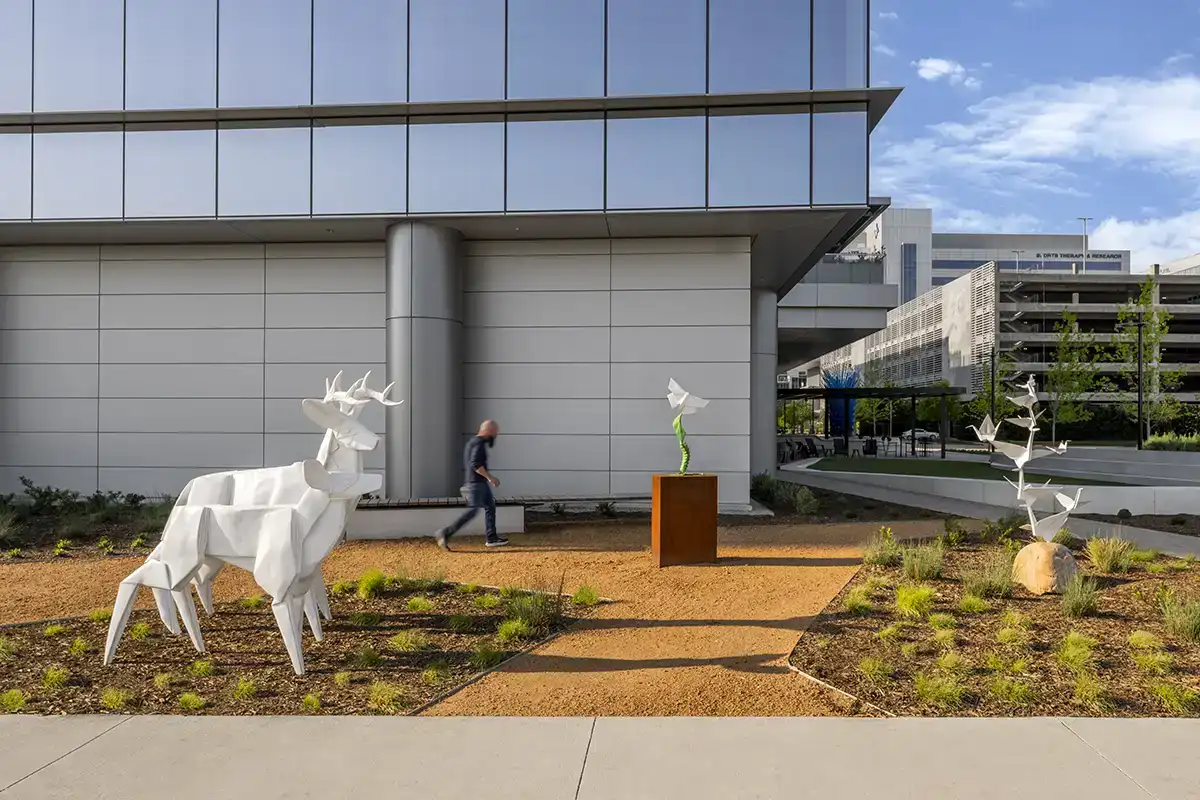
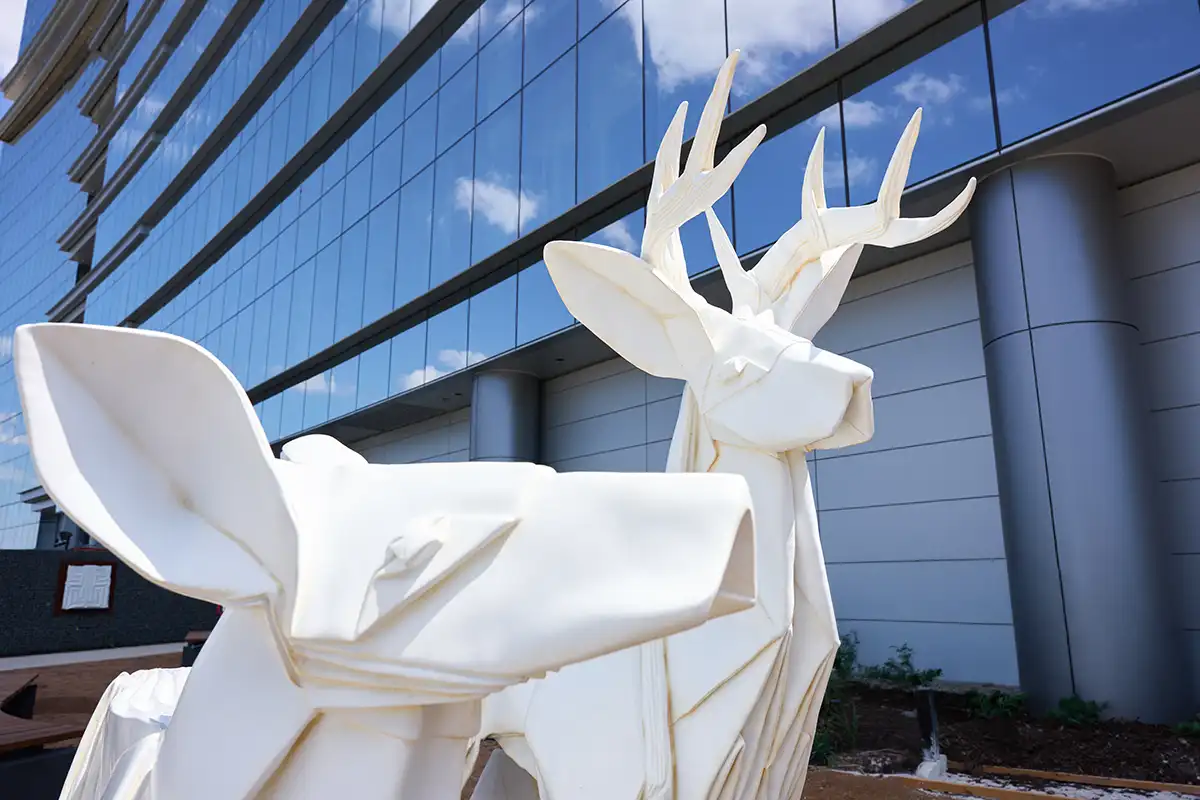
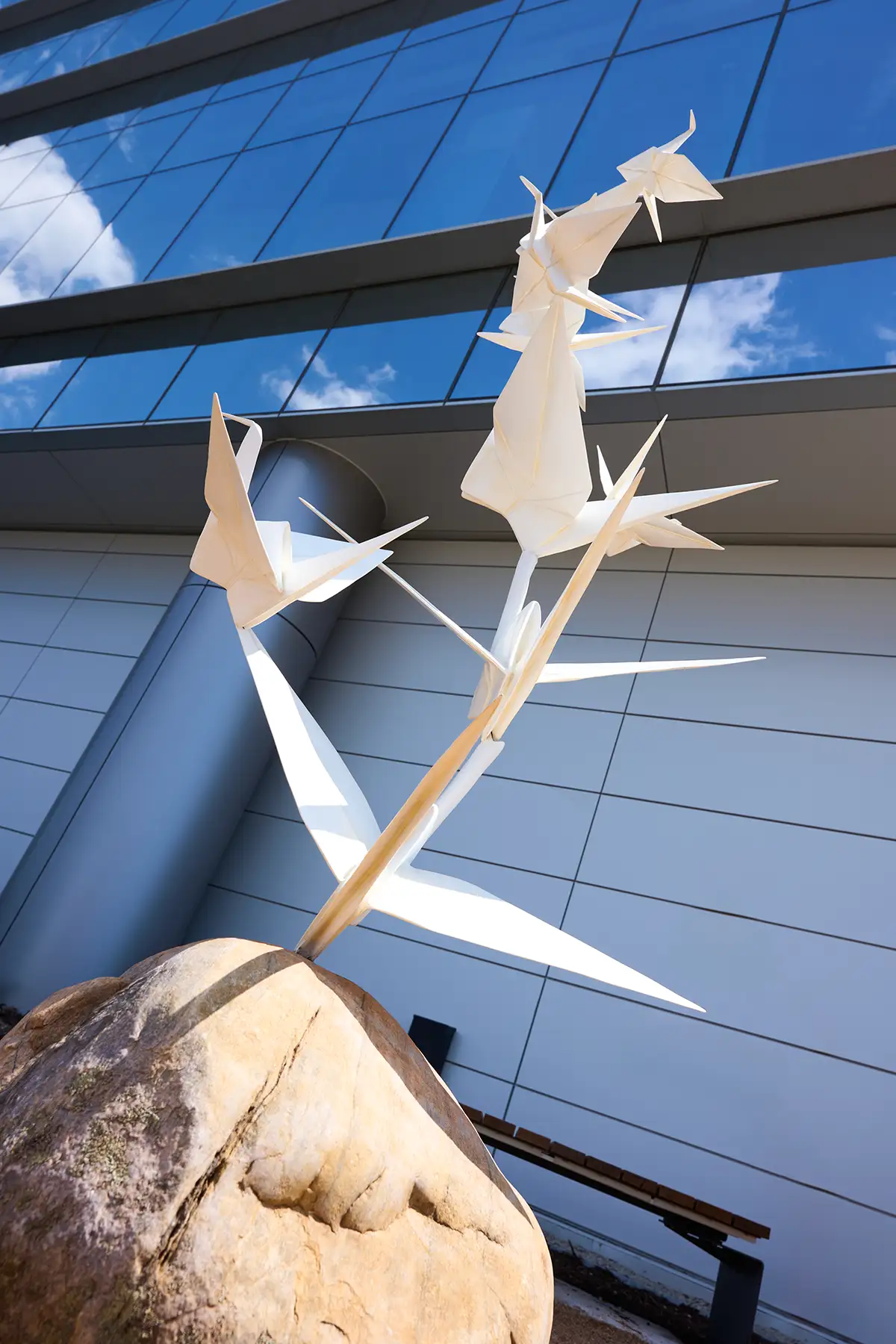
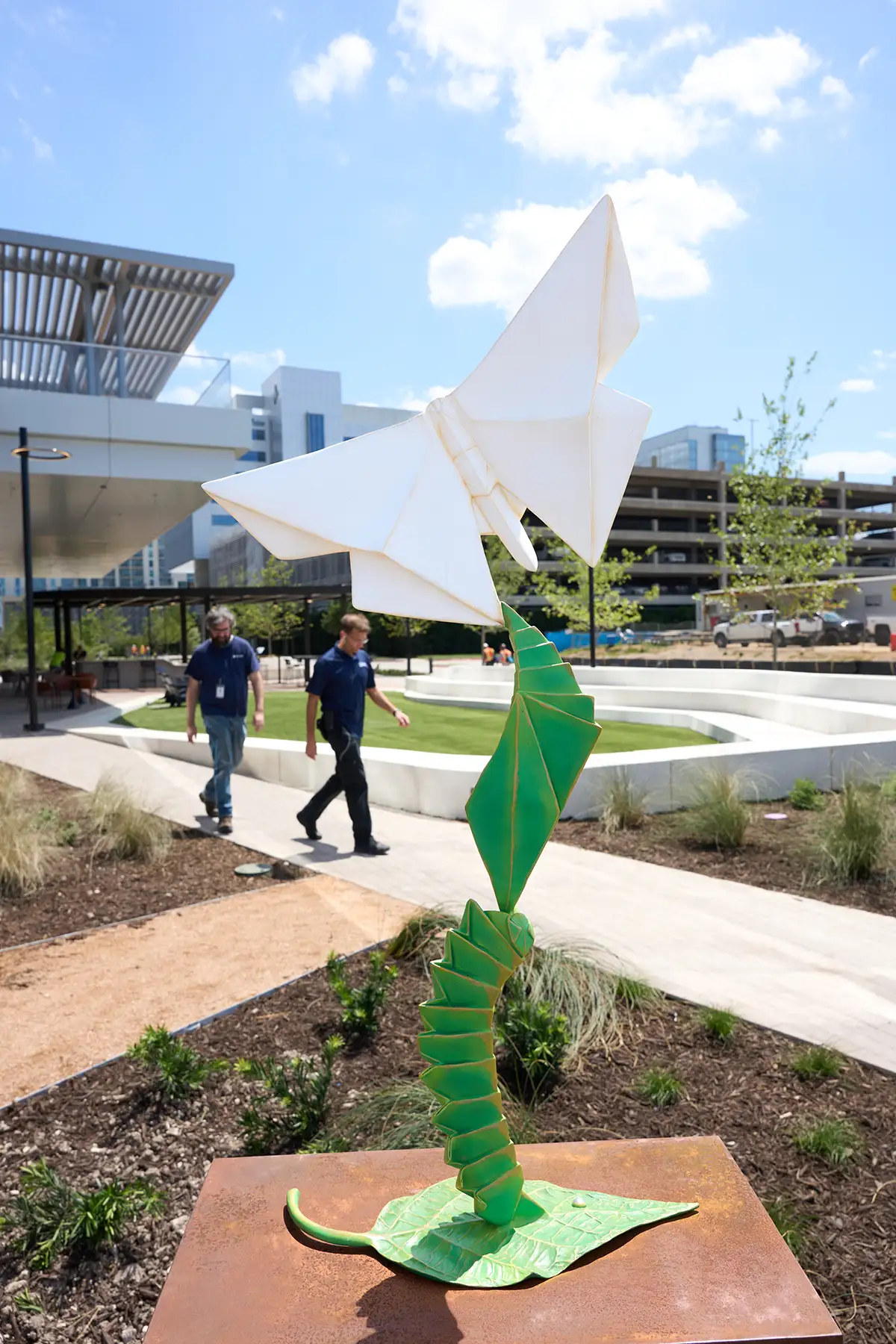
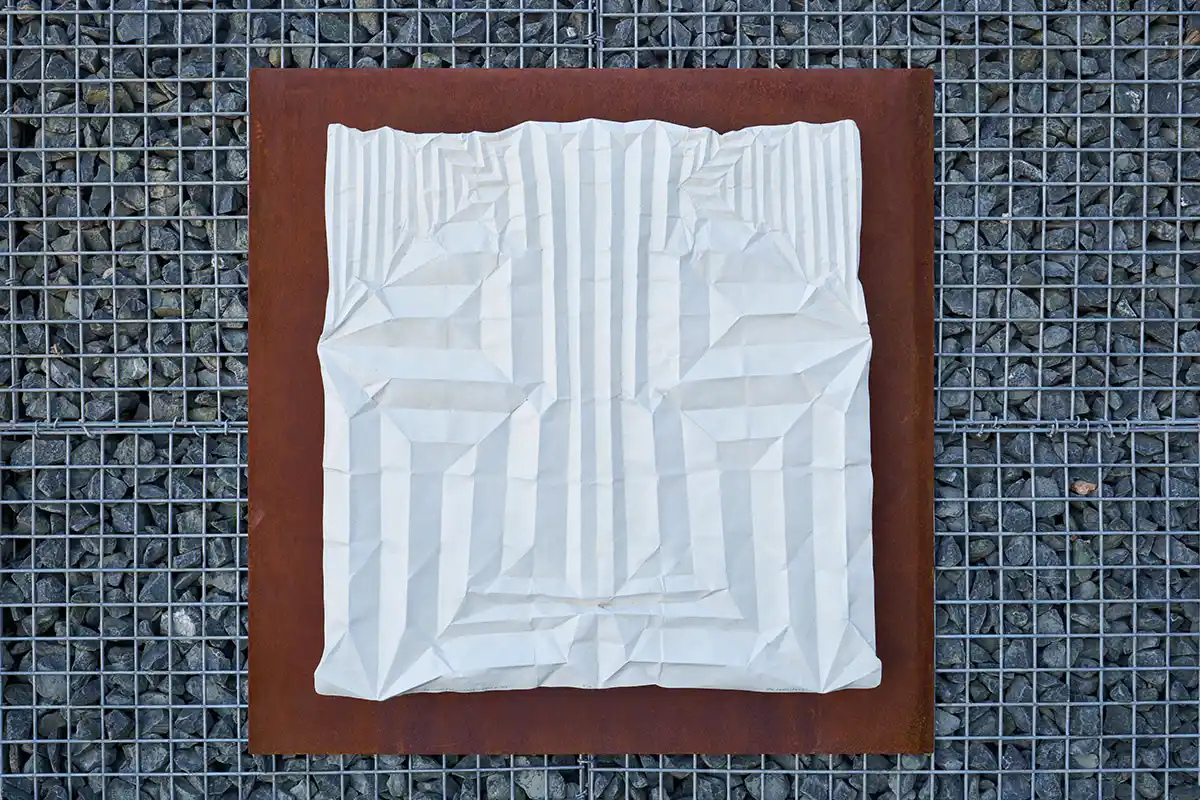
Unofficially nicknamed “Zen Garden,” this rock garden sitting area provides a quiet place to decompress. Multiple large-scale, origami-inspired sculptures were procured in keeping with the intended experience. Each sculpture is modeled after a real, paper origami figure then engineered and cast into stainless steel at a much larger scale. The surfaces are coated in white powder and finely waxed to create a subtle, paper-like finish. In keeping with the Texas terrain concept, the committee selected figures of deer (a buck and a doe), cranes, a caterpillar transforming into a butterfly and a sculpture of the unfolded paper used to make the origami buck figure.
Gallery: In a quiet rock garden outside TIAA’s offices, large-scale, origami-inspired sculptures set the mood for relaxation and reflection.
4. Unexpected Place
Tucked away from the rest of the grounds is a little seating area that unexpectedly appears as you round the corner from a busier spot. “Unexpected” is exactly what you’ll think when you realize the bronze and stainless-steel sculpture located there is by one of Texas’ most renowned and collected contemporary artists. The sculpture, called “Walking Flower,” asks the viewer to contemplate the unexpected: A flower “walks.” It traverses the landscape as a seed, floats on the breeze or in the water, and finally lands somewhere to become a flower. This unexpected opportunity to experience wonder is inconspicuously placed, like an Easter egg, for employees to discover and enjoy.
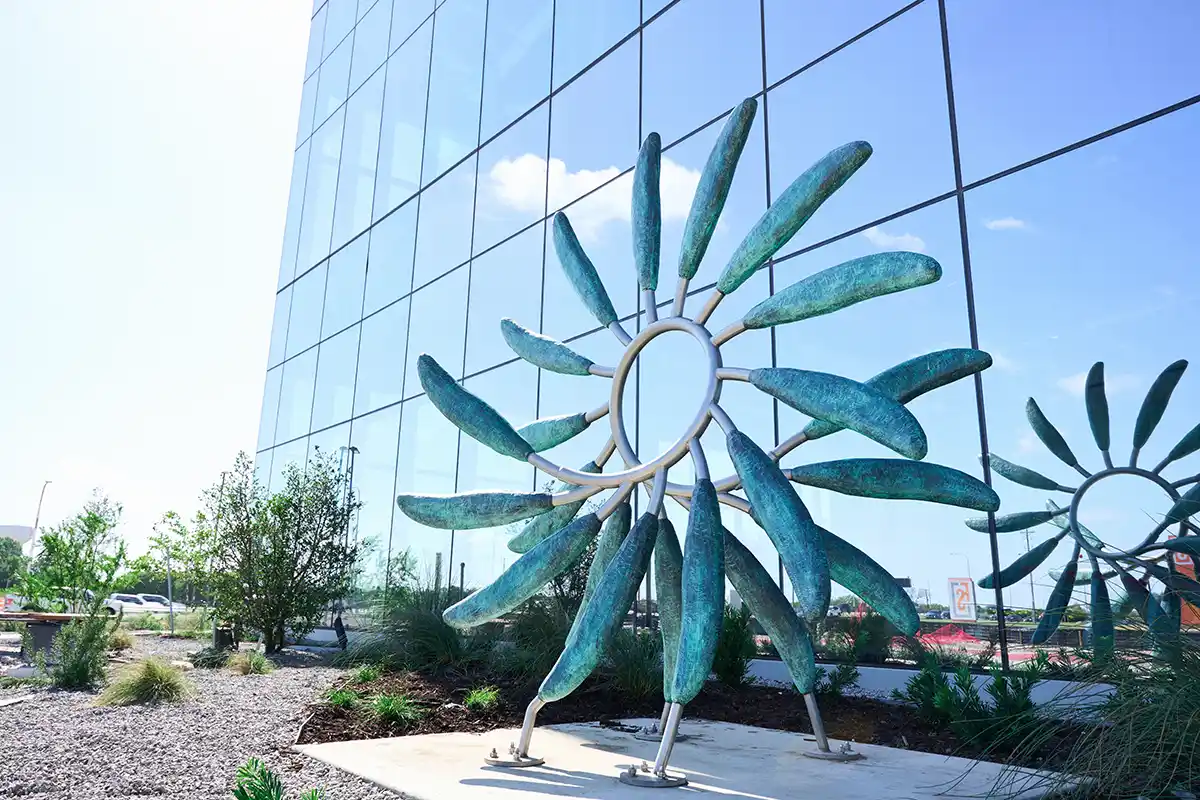
An unexpected bronze and steel sculpture by one of Texas’ most renowned contemporary artists is tucked away on the grounds at TIAA’s offices in Frisco, Texas.
Boots on the Ground: The Crucial Role of the Art Consultant
In addition to leading the art selection committee, the art consultant on this project provided detailed logistical coordination of the six large-scale sculpture installations. Experienced at working with architects, general contractors (GC’s) and trades, she was regularly on site to ensure the installations were on schedule, identifying any potential issues early and quickly pivoting with solutions. Here are just a few of the details managed during that project.
- Ensuring the “Bluebonnet” sculpture area was properly wired for electricity and data before the concrete was poured.
- Following up with the GC to ensure the foundation and planter for one of the sculptures was constructed by the time the artist arrived from out of state to install the sculpture.
- Coordinating between the artist and TIAA’s IT team to ensure there was a dedicated, secure internet connection for the “Bluebonnet” sculpture that met both parties’ requirements.
- Having contingency plans in place for all sculptures that allowed for safe storage of delivered artwork when weather delayed construction of display sites.
- Vetting artist materials, from finishes to digital components, to ensure they can withstand extreme heat and other Texas weather conditions.
Take-Aways for Architects
- Plan early for experiential art – Take a look at the site plan and mark areas where you think art could enhance the intended experience.
- Tell a story with the art – Don’t miss the opportunity to select art that tells the story of the space and completes your vision.
- Don’t try to do it all yourself – Bringing an experienced art consultant onto your project means having an expert in art logistics and installation on your team. One who knows how to work directly with your GC and other trades, saving you invaluable time and stress.a
Conclusion
Experiential art creates dynamic, engaging spaces that people want to use. To do it successfully, however, requires detailed oversight during every step of the process. Start with the site plan and select art based on a space’s intended use and the “vibe” you want to create. Coordinate with the GC and other trades to have any necessary wiring or platforms inserted into the construction schedule. Vet the artist’s materials and provide detailed oversight of the logistics for delivery and installation of the art. Alternatively, consider working with an art consultant who can work directly with your construction team and the artists to oversee the entire project from start to finish.
Learn More about How Experiential Art Creates Identity and Transforms Settings
- TIAA Project Page
- For some D-FW workers, returning to office has never been so good [Dallas Morning News]
- 6 Surprising Reasons TIAA Prioritizes Art at The Office
- Beyond Aesthetics: Why Art is a Competitive Differentiator [Facilitiesnet]
- TIAA fills new office tower with hundreds of workers, lush amenities: Outdoor amenities offer a relaxing oasis while an indoor open concept pushes a playful integration of departments. [Dallas Business Journal] (Subscription required)
- TIAA Wins the Commute with One of “DFW’s Coolest Offices”